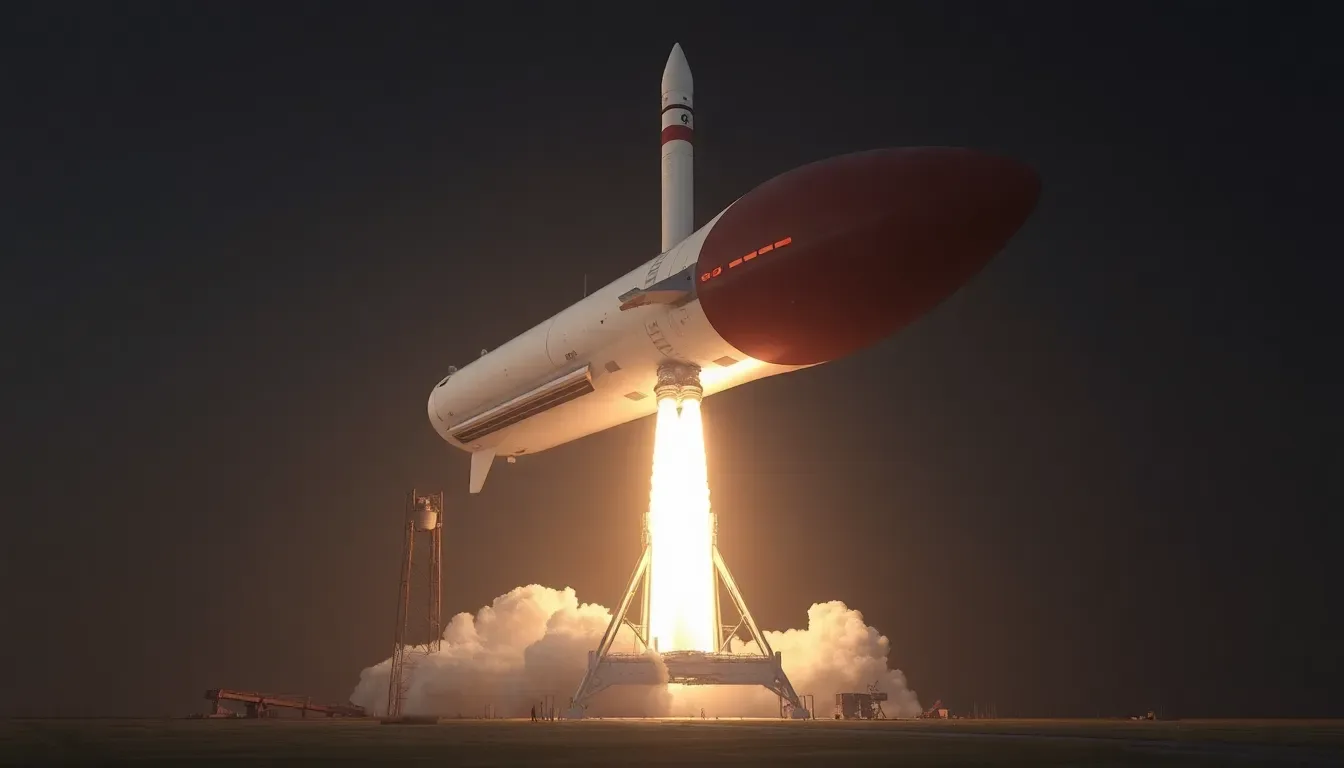
SpaceX continues to push the boundaries of aerospace engineering, showcasing feats that often seem like they belong to the realm of science fiction. One of their latest achievements is a stunning demonstration of the Super Heavy booster, which has not only impressed space enthusiasts but also sparked discussions about the future of space travel and rocket recovery systems. In a recent flight test, the Super Heavy booster executed a maneuver so graceful that viewers likened it to something generated by artificial intelligence. This moment marks a significant step forward in SpaceX’s journey toward reusable and sustainable space exploration.
Super Heavy’s impressive hover maneuver
During its 11th flight test, the Super Heavy booster, standing nearly 400 feet tall, executed a flawless return to Earth. The highlight of the test was a remarkable hovering maneuver above the Gulf of Mexico that lasted several seconds before the booster made a soft landing in the water. This showcase of balance and stability was unprecedented for such a large rocket and demonstrated SpaceX’s commitment to maintaining its leading position in the aerospace industry. The precision of the maneuver drew comments from viewers on social media, with many joking that the performance appeared to be digitally rendered.
- The Super Heavy booster is the most powerful rocket ever built, designed to lift heavy payloads into orbit.
- SpaceX aims to achieve full reusability, significantly reducing the cost of space travel.
- This test marks a key milestone in SpaceX’s development of the Starship program.
- Hovering capabilities could enhance the safety and reliability of future missions.
Such impressive performance underlines SpaceX’s innovative approach to rocket recovery. As the company gears up for the next phase of its Starship program, the successful execution of these maneuvers reaffirms its technological prowess and vision for the future of interstellar travel.
A look at Starship V2’s final performance
Flight Test 11 not only showcased the Super Heavy booster but also achieved critical objectives set by SpaceX. According to Space.com, the test involved deploying Starlink mass simulators and successfully relighting Raptor engines in space, alongside stable reentry for both the upper stage and the booster. This successful test serves as a farewell to the Starship V2 vehicle, as SpaceX prepares to transition to the upgraded Starship V3.
Starship V3 is designed to enhance performance in several key areas:
- Faster turnaround times between flights.
- Increased payload capacity, allowing for more ambitious missions.
- Enhanced reliability and safety features to further reduce risks during launches and recoveries.
Looking ahead, Elon Musk has indicated that SpaceX aims to attempt a “tower catch” for the Starship Upper Stage as early as spring 2026. This ambitious goal reflects the company’s ongoing commitment to innovation and efficiency in space travel.
The future of Tesla’s autonomous driving technology
In parallel to SpaceX’s advancements, Tesla is making significant strides in autonomous driving technology. Recently, Elon Musk announced that Tesla vehicles operating within the Boring Company’s Vegas Loop will soon be completely driverless. This underground transport system has been a focal point for Tesla’s Full Self-Driving (FSD) technology, which aims to revolutionize transportation in urban environments.
The Boring Company’s Vegas Loop currently has plans to expand significantly, featuring over 100 stations across 68 miles of tunnel. Tesla’s vehicles, primarily Model 3 and Model Y, are already equipped with the FSD suite, but have been operating with safety drivers until now. Musk’s announcement suggests an imminent shift to fully autonomous operation.
Innovative insurance for Tesla’s Full Self-Driving
In a notable development, Shai Wininger, co-founder of Lemonade, has proposed to insure Tesla’s FSD miles for “almost free.” This groundbreaking offer comes as Tesla vehicles traditionally struggle with higher insurance costs due to advanced technology and repair expenses. Wininger’s idea leverages Tesla’s robust data capabilities to provide accurate assessments of driving behavior, potentially making insurance more affordable for Tesla owners.
- The integration would eliminate the need for traditional usage-based insurance (UBI) devices.
- It aims to encourage Tesla owners to utilize the FSD suite, further promoting its adoption.
- The offer could lead to lower overall costs for Tesla drivers in states where Tesla’s in-house insurance is not available.
This partnership represents a significant step towards making electric and autonomous vehicles more accessible to everyday consumers, aligning with Tesla’s broader mission of sustainable transportation.
Elon Musk’s ambitious pay package faces scrutiny
Elon Musk’s proposed $1 trillion pay package from Tesla has sparked controversy and received pushback from proxy advisory firm Institutional Shareholder Services (ISS). This compensation plan is designed to incentivize Musk to remain as CEO for the next decade while tying his earnings to the company’s growth and shareholder value. However, ISS has raised concerns regarding the structure of the deal, calling it “astronomical” and warning that it could hinder the board’s ability to adjust future compensation effectively.
The implications of this pay package are significant:
- If Musk achieves all performance targets, Tesla’s market capitalization could soar to $8.5 trillion, making it the most valuable company globally.
- Concerns about potential dilution for existing investors have been highlighted.
- The package is also viewed as a strategic move to secure Musk’s influence over Tesla amidst pressure from “activist shareholders.”
Tesla is actively seeking to persuade shareholders to support the pay proposal, emphasizing its importance to attract and retain leadership that drives innovation and value creation.
As SpaceX and Tesla continue to innovate and redefine their respective industries, the intersection of aerospace and automotive technology signals an exciting era of advancements. From the successful recovery of rocket boosters to the deployment of autonomous vehicles, these developments are paving the way for a future where space exploration and sustainable transportation can thrive together.