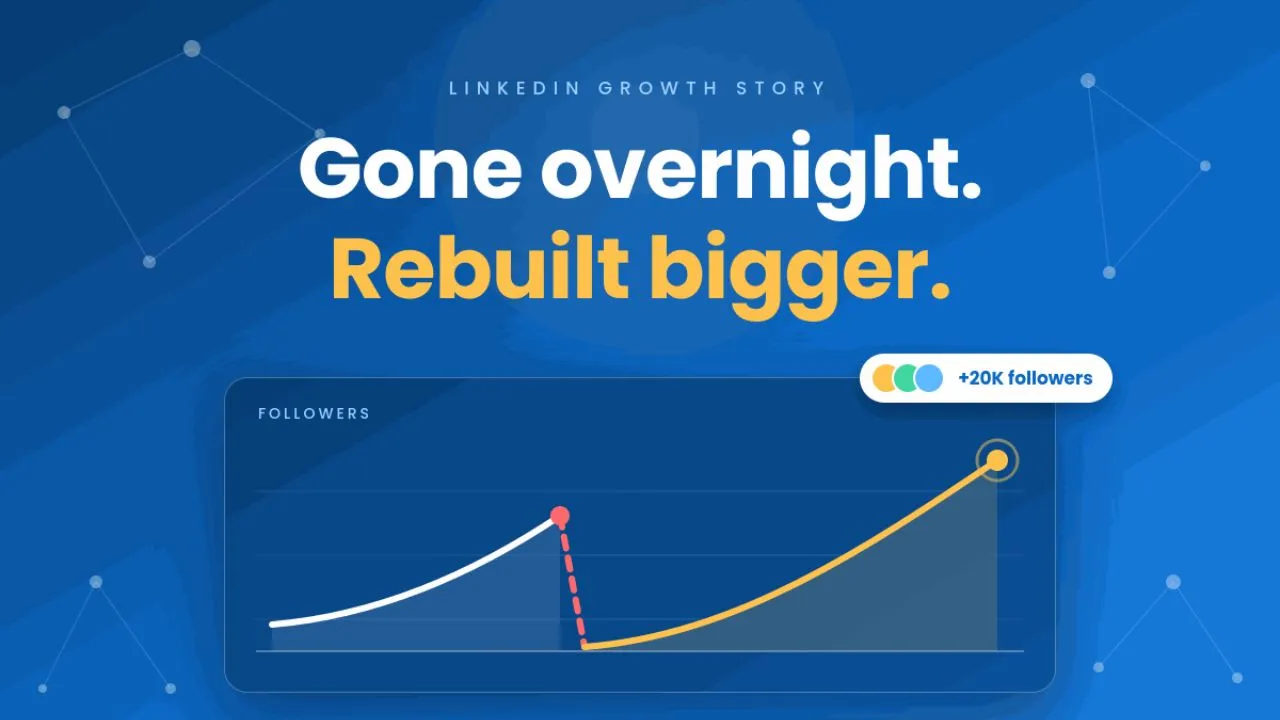
The email arrived on a Tuesday morning: my LinkedIn account — 19,400 followers, four years of daily posting, the source of almost every client I had — was restricted. Two weeks later, the restriction became permanent. No warning I could act on, no appeal that went anywhere, no backup plan, because I had never imagined needing one.
That same quarter, my biggest client left. Between the account and the contract, roughly 80% of my income disappeared in under sixty days.
Here’s the part that makes this story worth your time: eighteen months later, my rebuilt LinkedIn audience was larger than the first one, growing faster, and generating more revenue per follower than the original ever did. Not because I got lucky twice, but because losing everything forced me to figure out which parts of my first growth were skill and which parts were accident.
This is the complete account of both climbs — what built the first audience, the mistakes that made losing it catastrophic instead of inconvenient, and the exact system I used to rebuild from zero. If you’re starting from nothing, starting over, or quietly terrified that your audience could vanish tomorrow, this was written for you.
The First Climb: How I Built 19K Followers the Slow Way
My first LinkedIn audience took four years, and honestly, the first two of those years barely count. I was doing what most professionals do: sharing company updates, congratulating people on work anniversaries, and posting the occasional article that six people read, two of whom were relatives.
The growth started when I made one uncomfortable change: I stopped writing about my industry and started writing about what I was actually doing inside it — the projects, the numbers, the client conversations that went badly, the pricing mistakes. The week I published a post breaking down exactly how I lost a client by underpricing a project, my reach multiplied by ten overnight.
That taught me the first durable law of LinkedIn growth: specific experience beats general expertise, every single time. Anyone can write “5 tips for better client communication.” Only you can write about the Thursday call where a client fired you and what you’d say differently now. The platform is drowning in advice and starving for evidence.
From there, the first climb followed a pattern I didn’t fully understand at the time:
- Posting three to four times per week, mostly stories from real work
- Replying to every comment, usually within the first hour
- Slowly attracting inbound leads, which became clients, which became more stories to tell
It worked. Slowly, compounding, imperfectly — but it worked. By year four I had 19,400 followers, a full client roster sourced almost entirely from the platform, and a dangerous amount of confidence that none of it could go away.
Losing Everything: What Actually Happened
I want to be precise here, because “I lost my account” invites the assumption that I did something reckless. The honest answer is more uncomfortable: I still don’t know exactly which trigger caused the restriction, and that uncertainty is itself the lesson.
In the months before it happened, I had been doing several things that, in hindsight, sat in gray territory:
- Using a third-party automation tool to send connection requests while I slept
- Logging in from multiple devices and locations, including a VPN that jumped countries
- Sending high volumes of near-identical DMs during a launch
Any one of those can look like bot behavior to an automated system. Combine them in the same window and you’re rolling dice with your entire professional presence. The restriction email cited “activity that violates the User Agreement” — vague enough to be unfightable. My appeals got template responses. After two weeks, the account was gone for good, along with every post, every testimonial in the comments, and every one of those 19,400 relationships.
The client loss that same quarter was unrelated and ordinary — a budget cut on their side — but the timing turned two survivable problems into one existential one. My pipeline had exactly one source, and that source had just been deleted.
If you take a single sentence from this article, take this one: a platform account is not an asset; it’s a lease, and the landlord can end it without cause. I built a business on rented land and acted surprised when the lease ended.
The Three Mistakes That Turned a Setback Into a Catastrophe
Losing the account was bad. These three decisions — all made years earlier, all invisible until the crisis — are what made it devastating.
Mistake 1: I never moved the audience anywhere I owned
Nineteen thousand followers, and I had email addresses for maybe forty of them. Every relationship lived inside LinkedIn’s walls. When the account died, I had no way to tell my own audience what had happened or where to find me. Years of trust, unreachable overnight.
The fix is almost embarrassingly simple: an email list, mentioned regularly, offering something worth subscribing to. I resisted it for years because “my audience is on LinkedIn, why would they want emails?” The answer arrived the hard way: because email is the only audience channel where no algorithm, policy team, or automated flag sits between you and the people who chose to hear from you.
Mistake 2: One platform, one pipeline, one point of failure
Every client for four years came from the same source. That’s not a marketing strategy; it’s a single point of failure wearing a strategy costume. It felt efficient — why spread thin across platforms when one was working? — but efficiency and fragility are often the same thing viewed from different angles.
Mistake 3: I automated the one thing that should stay human
The automation tools felt like leverage. Send 400 connection requests a week while sleeping! In reality I was paying a subscription to put my account in danger while making worse connections than twenty minutes of manual, thoughtful outreach produced. The math never favored automation; I just never did the math. The accounts that survive for a decade on LinkedIn are, almost without exception, boringly manual about connections and DMs.
Starting From Zero, Again: The First 30 Days
Twelve days after the permanent ban, I created a new profile. Zero followers, zero posts, zero proof I had ever existed on the platform. Here’s exactly how the first month went, because the first month is where most people starting from nothing quit.
Week 1: The profile is the landing page
Before posting anything, I rebuilt the profile as if it were a sales page, because that’s what it is. Every person who likes your post and considers following you looks at three things in about four seconds: your photo, your headline, and your banner.
- Headline: not a job title, but a value statement — who I help, with what outcome. “Marketing consultant” says nothing; “I help B2B service firms turn expertise into inbound clients” tells a stranger in one line whether to follow.
- Featured section: my three best pieces of proof — a case study, a testimonial screenshot, and a link to my new email list. From day one this time. Never again without the list.
- About section: written in first person, structured as a story, ending with a clear way to work with me.
Weeks 2–4: Comments before content
Here is the counterintuitive move that made the second climb faster: for the first month, commenting was my content strategy. With zero followers, publishing posts is performing to an empty room. But a sharp, specific comment on a large creator’s post gets seen by thousands of people who are already engaged and already interested in your topic.
My daily routine was rigid: thirty minutes, ten to fifteen comments on posts in my niche, each one adding a specific point, a mild disagreement with reasoning, or a short example from experience. Never “Great post!” — a comment that could be left by anyone builds an audience for no one.
By day 30 I had roughly 600 followers without a single viral post. More importantly, I had trained the habit that would carry everything after: showing up daily whether or not anyone was watching.
The Content System That Grew Faster the Second Time
The first audience took four years. The second passed 20,000 followers in about eighteen months. The difference wasn’t harder work — it was replacing improvisation with a system.
Three content pillars, and only three
Everything I publish fits one of three buckets, chosen deliberately:
- Proof — case studies, project breakdowns, numbers from real work. This pillar builds authority and attracts clients.
- Process — how I do specific things, in enough detail that a reader could copy it. This pillar earns saves and follows, because usefulness is the most followable trait on the platform.
- Perspective — opinions about where my industry is wrong, told through stories. This pillar creates the disagreement and conversation that the algorithm feeds on, and it’s the one that makes people remember you rather than just your tips.
The discipline is in what gets excluded. Motivational quotes, trending-topic hot takes outside my lane, engagement-bait questions — all of them can get reach, and none of them attract the right audience. Reach among the wrong people is a vanity metric with a dopamine coating.
The anatomy of a post that works
After hundreds of posts across both climbs, the structure that consistently performs has four parts:
The hook (line one and two). On LinkedIn, everything below the first two or three lines hides behind “…see more.” Those first lines have one job: create an open loop the reader must close. Compare “Today I want to talk about pricing” with “A client just paid me 3x my old rate for the same work. The difference was one sentence in my proposal.” The second is a door left ajar.
The story or evidence (the middle). Short paragraphs. One idea each. White space is not decoration on LinkedIn; it’s respiration — dense blocks of text die in the feed regardless of how good the thinking is.
The insight (the turn). The moment the specific story becomes a general lesson the reader can use. Without this, you’ve told an anecdote. With it, you’ve delivered value they’ll associate with your name.
The invitation (the end). A genuine question or a simple prompt for discussion. Not “Agree? ♻️ Repost!” — the algorithm rewards conversation, and conversation follows questions people actually want to answer.
Writing in batches, publishing daily
The single biggest operational change: I stopped writing posts on the day they published. Every Sunday, ninety minutes, five posts drafted from an ideas file I feed all week. Daily publishing then becomes a two-minute task instead of a daily creative crisis, and consistency — the only growth lever that works for everyone — stops depending on mood.
Where do the ideas come from? Client questions, mistakes I watch people make, conversations in my DMs, and comments on my own posts that deserve a fuller answer. An audience, even a small one, is a permanent idea-generation machine if you listen to it.
How the LinkedIn Algorithm Actually Rewards You
There’s an entire cottage industry of algorithm mythology — magic posting times, banned words, secret penalties. Most of it evaporates under testing. What held true, consistently, across two full audience builds:
The first hour decides the day. LinkedIn shows a new post to a small slice of your network and watches what happens. Strong early engagement expands distribution; silence buries it. This is why replying to early comments fast matters so much — every reply is new engagement in the decisive window, and it doubles the comment count.
Dwell time beats reactions. The platform measures how long people stop on your post. This quietly explains why storytelling outperforms listicles, why document carousels do well (each swipe is time), and why a post someone reads twice beats a post someone likes reflexively while scrolling past.
Comments outweigh everything else. A comment costs the reader more effort than a like, and effort is the signal. Fifteen real comments will carry a post further than a hundred silent reactions.
External links get less reach — usually. Posts whose job is to send people off-platform tend to travel less. My workaround is boring and effective: deliver full value in the post itself, and put the link in the comments or mention that it’s in my profile. The post earns the audience; the profile converts it.
Consistency compounds; virality doesn’t. My most viral post of the second climb brought 3,000 followers in a week — and engagement dropped for a month afterward, because most of those people followed a moment, not me. The audience that buys, refers, and stays came from two hundred unremarkable, useful posts in a row. Chase the base rate, not the outlier.
The Invisible Half of Growth: Comments and DMs
Ask people how to grow on LinkedIn and they’ll talk about posting. But roughly half of my second climb happened in places nobody can see.
The commenting habit from month one never stopped — it just got more strategic. Fifteen minutes before and after publishing my own post, I comment on others in my niche. This does three things at once: it keeps me visible between my own posts, it warms up my network right before my content goes live, and it builds relationships with creators whose audiences overlap mine.
The DM layer matters even more, and it’s where most people either do nothing or do something gross. My rules:
- When someone comments thoughtfully several times, I send a short, genuine thank-you DM. No pitch. Nothing to click.
- When someone new follows me and their profile is interesting, a two-line hello asking what they’re working on.
- When someone asks a question in comments that deserves ten minutes instead of two sentences, I take it to DMs and actually help.
None of this scales, which is exactly why it works. Every serious opportunity of the second climb — clients, partnerships, two speaking invitations — started as a conversation in DMs, and every one of those conversations started without an agenda. People can smell a funnel. They can also recognize a human, because it’s become rare.
First Climb vs. Second Climb: What I Changed
| Aspect | First audience (4 years) | Second audience (18 months) |
|---|---|---|
| Posting rhythm | 3–4x per week, improvised | Daily on weekdays, batched on Sundays |
| Content focus | Whatever felt interesting | Three fixed pillars: proof, process, perspective |
| Commenting | Replies to my own posts only | 10–15 strategic comments daily on others’ posts |
| Connections | Automated tools (the fatal error) | 100% manual, personalized |
| Email list | Ignored for four years | Built from day one, promoted weekly |
| DMs | Launch blasts | Relationship-first, no automation, no scripts |
| Measurement | Follower count | Profile visits, email signups, inbound conversations |
| Risk posture | Everything on one platform | Audience mirrored off-platform continuously |
The pattern across every row: the first climb optimized for speed of growth, the second for durability of growth — and the durable version turned out to be faster anyway. That still surprises me, but it shouldn’t. Trust compounds quicker than tricks.
Realistic Timelines: What to Expect Month by Month
Nothing damages new creators more than calibrating expectations against outliers. Here’s what starting from zero actually looked like the second time, as someone with experience, a clear niche, and two hours a day. Adjust downward if you’re figuring out your niche as you go — that’s normal, and it’s how the first climb went for me.
Months 1–2: The silent grind. A few hundred followers, mostly from commenting. Posts getting 5–20 reactions. This phase filters out almost everyone, which is precisely the opportunity.
Months 3–5: First signals. Around 1,000–2,500 followers. One or two posts break out of your immediate network. First inbound DMs from strangers. The habit is now load-bearing.
Months 6–9: Compounding begins. Reach becomes less dependent on any single post. Somewhere in this window came my first serious client of the rebuild — not from a viral post, but from someone who’d quietly read everything for four months. That’s the typical shape of LinkedIn revenue: long silent observation, then a DM that starts with “I’ve been following your posts for a while.”
Months 10–18: The flywheel. Growth accelerated past the first climb’s pace. More audience means more comments means more ideas means better posts means more audience. The system runs on maybe seven hours a week at this stage — the heavy lifting is behind you.
What if you’re three months in and nothing is happening? Audit in this order: hooks first (are people stopping?), specificity second (could anyone else have written this post?), consistency third (has it truly been daily, or daily-ish?). In almost every stalled account I’ve reviewed since, the answer lived in one of those three.
Never Again: How I Made My Audience Un-Losable
The rebuilt audience is bigger than the first, but that’s not the achievement I’m proudest of. The achievement is that losing this account tomorrow would be an inconvenience, not an extinction event. Here’s the insurance structure, in order of importance:
The email list is the real audience. Every week, at least one post points to a genuinely valuable free resource that requires an email. A meaningful percentage of my LinkedIn followers now also live on a list I own outright. If the account vanished tonight, tomorrow morning those people get an email explaining exactly where to find me.
Connections get exported monthly. LinkedIn lets you download your connections data, including many email addresses, from your account settings. It takes five minutes. A calendar reminder on the first of each month does it religiously. This one habit would have saved me years of rebuilding the first time.
Content lives in my own archive first. Every post is written in my own document system and published to LinkedIn, never composed only inside it. Four years of my first account’s writing evaporated with the ban; nothing I write now can be deleted by anyone but me. That archive also feeds the newsletter and gets repurposed elsewhere, so the habit pays for itself twice.
Rented land stays clean. No automation touching the account. No engagement pods. No login patterns that look robotic. Boring compliance is a competitive advantage when the penalty for gray areas is deletion — I am, quite literally, the cautionary tale.
A second channel, deliberately small. The newsletter doubles as this. It doesn’t need to rival LinkedIn; it needs to exist, grow slowly, and be entirely mine. Diversification isn’t about being everywhere — it’s about never again having a single point of failure.
“But What If…” — The Objections That Keep People at Zero
Every time I’ve told this story, the same three objections come back. They deserve real answers, because each one kept me stuck at some point.
“What if I don’t have a niche yet?” Then borrow the one you already work in. Your niche at the start is simply the job you do, described honestly — the problems you solve on Tuesdays, the mistakes you watch people make, the questions clients keep asking. Positioning sharpens through publishing, never before it. I refined my niche three times across both climbs, and each refinement came from noticing which posts brought the right people into my DMs. You cannot think your way to a niche from the sidelines; the feedback that defines it only exists once you’re posting.
“What if my employer sees my posts?” This fear stops more potential creators than any algorithm ever will, and it’s usually miscalibrated. Writing thoughtfully about your field makes you more valuable to a current employer, not less — visible expertise reflects on them too. The genuine rules are narrow: never share confidential client or company information, never post what you wouldn’t say in a meeting, and if you’re planning an exit, build quietly around your craft rather than your grievances. Within those lines, the professional who publishes has more options than the one who doesn’t, in every scenario I’ve watched play out.
“What if I write for months and nobody cares?” You will, and at first they won’t — plan on it rather than fearing it. The silent months aren’t a verdict; they’re tuition. Every post in the empty room is a repetition: hooks get sharper, stories get tighter, your voice stops imitating and starts sounding like you. The people who broke through in my niche all have the same buried archive of posts with four likes. The ones who quit at month two don’t have a different talent level; they have a different relationship with silence. Decide before you start that the first ninety days are practice in public, and the silence loses its power to stop you.
Frequently Asked Questions
Can you really rebuild a LinkedIn audience after losing your account?
Yes, and usually faster than the first build, for a reason that has nothing to do with the platform: you keep the skill. The audience was never the asset — the ability to build an audience was. Writing, positioning, consistency, and relationship habits all survive a ban intact. My second 20,000 took less than half the time of my first 19,000, with a better audience at the end.
How often should I post on LinkedIn to grow?
Daily on weekdays is the ceiling worth pursuing; three quality posts per week is a fully viable floor. Below that, momentum leaks between posts. Above once daily, you cannibalize your own reach and, more dangerously, run out of things worth saying. Frequency never rescues weak content — fix specificity before schedule.
No, and mildly targeting virality can hurt. Viral posts attract passersby; useful posts attract followers; personal posts attract believers. The audience that generates clients and opportunities is built from the second and third categories. My most commercially valuable posts of the second climb rarely exceeded a few hundred reactions.
Is it worth starting on LinkedIn from zero right now, with all the competition?
The feed is more crowded; genuine specificity is not. The overwhelming majority of LinkedIn content remains generic advice, recycled frameworks, and AI-flavored filler — which means a person writing from verifiable, specific experience stands out more today, not less. Zero is also where everyone I know with a valuable audience started, including me. Twice.
How do I grow on LinkedIn without spending money on ads?
Everything in this article was organic; I’ve never run a LinkedIn ad for my own brand. The organic levers, in order of impact: a profile that converts visitors, daily strategic commenting, consistent posts built on specific experience, fast replies in the first hour, and human DMs. Ads can amplify a working system; they cannot substitute for one.
What’s the biggest mistake people make when trying to grow a LinkedIn audience?
Treating follower count as the goal. Followers are a byproduct of being consistently useful to a specific type of person. The accounts that stall are almost always broadcasting at an imagined audience instead of talking with a real one — and the accounts that get banned are almost always trying to shortcut with automation what only shows up through repetition. I managed to make both mistakes. You only need to make neither.
The Lesson Under All of It
People assume the story of losing 19,400 followers is a tragedy with a redemption arc. Living through it felt different. Losing everything was the most expensive education of my career, and — I say this without a trace of motivational-poster intent — it was worth close to what it cost.
Because here’s what the second climb proved: the audience was never the thing I built. The thing I built was a person who knows how to earn attention honestly, convert it into trust, and protect it like the business asset it is. Platforms can delete accounts. They cannot delete that.
So if you’re at zero — by choice, by disaster, or by never having started — your position is better than it feels. You get to build it right the first time: audience on the platform, relationships in the DMs, insurance in the email list, and everything you write archived on land you own.
Start with the profile. Then thirty minutes of real comments a day. Then one specific, honest post about something you actually did. That’s the whole beginning. The compounding takes care of the rest — it did for me, twice, and the second time it didn’t even need luck.