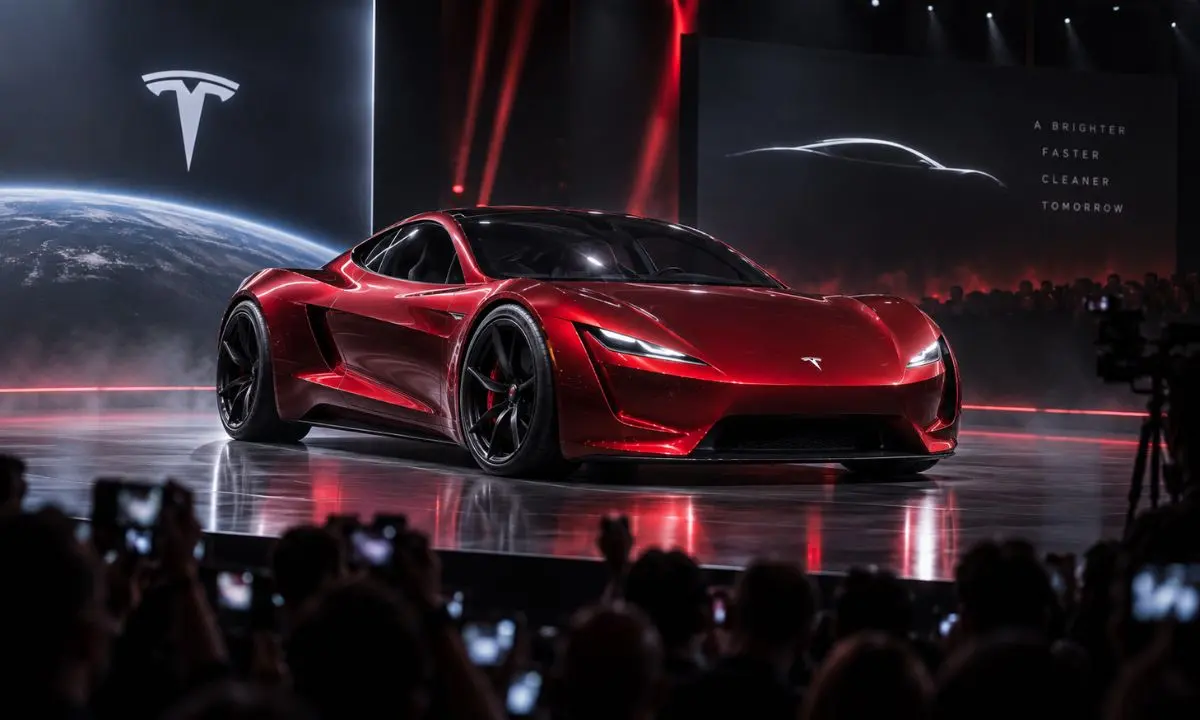
Elon Musk Says the New Tesla Roadster Will Be Revealed Very Soon
After years of delays, changing timelines and increasingly ambitious promises, the new Tesla Roadster finally has another date circled on the calendar: October 1, 2026.
This time, the announcement is more concrete than another vague “coming soon” comment from Elon Musk. Tesla itself published a “Go for launch” teaser showing the date 10.01, and Musk followed it by confirming that the new Tesla Roadster unveiling is scheduled for October 1.
For anyone who has followed this car since its dramatic 2017 debut, that date carries unusual weight. The second-generation Roadster was originally expected to reach customers years ago, yet nearly a decade later Tesla is still preparing to show what appears to be a substantially evolved version of the electric sports car.
The big question is no longer simply when Tesla will show the Roadster.
It is now:
What exactly will Tesla reveal on October 1—and how much of the extraordinary Roadster that Elon Musk has described over the years will actually become a production car?
Tesla Roadster Reveal: What We Know Right Now
Here is the clearest picture based on Tesla’s current information and its latest announcement.
| Detail | Current status |
|---|---|
| New Roadster reveal | October 1, 2026 |
| Date confirmed by Tesla | Yes |
| Production car shown? | Expected, but final production specification not yet confirmed |
| 0–60 mph claim on Tesla site | 1.9 seconds |
| Claimed top speed | Over 250 mph |
| Claimed range | 620 miles |
| Seating | Four |
| Removable roof | Yes, according to Tesla |
| SpaceX thrusters | Discussed by Musk, but not listed as a current standard specification |
| Final production price | Not confirmed |
| Customer delivery date | Not guaranteed yet |
| Official production status in Tesla’s 2025 year-end update | Design development |
Tesla’s current Roadster page continues to advertise a 1.9-second 0–60 mph time, a top speed above 250 mph and a claimed range of 620 miles. It also describes the car as a four-seat electric supercar with a lightweight removable glass roof that can be stored in the trunk.
Those numbers remain extraordinary, but there is an important distinction: they should not automatically be treated as final certified production specifications.
The Roadster remains under development, and Tesla’s own reservation terms state that the company is still determining the vehicle’s final options, features and hardware.
October 1 Is No Longer Just Another Roadster Rumor
Tesla’s September announcement makes this Roadster update different from many earlier predictions.
The company posted a graphic with the phrase “Go for launch” and the date October 1. Musk then reinforced it by stating that the new Tesla Roadster unveiling would take place on 10.01.
That announcement was independently reported on September 12, with the new event scheduled nearly nine years after Tesla first revealed the second-generation Roadster concept in November 2017.
Tesla has also placed a countdown on at least some versions of its official Roadster website, further indicating that October 1 is being treated as an actual company event rather than a casual prediction.
For readers following Tesla’s broader vehicle development, Diary OK has a dedicated Tesla News section covering new vehicles, EV technology and major company updates.
Why Has the New Tesla Roadster Taken So Long?
To understand why this October event matters, it helps to go back to 2017.
Tesla revealed the second-generation Roadster as a surprise during the Tesla Semi event. At the time, the car looked almost production-ready and arrived with performance claims that were difficult to believe for a road-going electric vehicle.
The expected launch window was originally 2020.
That obviously did not happen.
Over the following years, the Roadster repeatedly moved down Tesla’s priority list while the company concentrated resources on higher-volume programs, new factories, battery development, the Cybertruck, Tesla Semi, artificial intelligence, Full Self-Driving and eventually Cybercab.
Tesla has continued to insist that the Roadster remains alive, but its own year-end 2025 manufacturing update reveals how early the project still was relatively recently.
In that official document, Tesla listed the Roadster’s manufacturing region as “TBD” and its status as “Design development.” At the same time, Tesla said preparations were continuing for production of the next-generation Roadster.
That detail is particularly important.
It means that even while Musk was talking publicly about spectacular Roadster capabilities, Tesla’s own corporate documentation still classified the vehicle as being in design development.
What Will Tesla Actually Show on October 1?
Tesla has not yet publicly released a complete agenda detailing every element of the October 1 presentation.
That creates several possibilities.
Tesla could reveal a near-final production Roadster with updated exterior and interior design, announce new specifications and provide a production timeline.
Or the company could use the event primarily as a technology demonstration, especially if the long-discussed collaboration with SpaceX plays a major role.
Reports have suggested that Tesla could demonstrate a special version incorporating cold-gas thrusters connected to ideas Musk has discussed for years.
However, this distinction is critical:
Tesla’s current official Roadster product page does not list rocket thrusters as part of the normal Roadster specification.
Therefore, until Tesla presents the system and explains exactly how it will be sold, any SpaceX-equipped version should be treated separately from the specifications of the standard production car.
Will the Tesla Roadster Really Have SpaceX Rocket Thrusters?
This is easily the most unusual part of the Roadster story.
Musk has repeatedly discussed a SpaceX package that could use cold-gas thrusters to improve vehicle performance. Over time, his descriptions became even more ambitious, including suggestions that the Roadster could briefly lift or “hover.”
Recent reporting indicates that the October presentation could include a demonstration connected to that technology.
But several questions remain unanswered:
- How many thrusters would the car use?
- Would they replace rear seats?
- Would they be legal for street use?
- Would the system be available to normal customers?
- Would it be limited to a track-only version?
- How would the pressure system be refilled?
- How much additional weight would it add?
- What safety systems would be required?
- Would the claimed acceleration figures apply only to the SpaceX version?
Until Tesla provides engineering details, those questions remain open.
The Roadster’s October event could finally separate years of Musk’s public comments from the hardware customers will actually be able to buy.
How Fast Will the New Tesla Roadster Be?
Tesla’s current official U.S. Roadster page still lists:
0–60 mph: 1.9 seconds
Top speed: more than 250 mph
Range: 620 miles
Tesla also describes the Roadster as an all-electric supercar designed to maximize aerodynamic efficiency and performance.
Other official regional Tesla pages continue to display additional historical Roadster specifications, including an 8.8-second quarter mile and all-wheel drive.
But the October unveiling could significantly change those figures.
Musk has repeatedly indicated that Tesla increased the design goals beyond the original 2017 concept. Car and Driver notes that he later discussed acceleration below one second in connection with the redesigned car and SpaceX technology.
That creates an unusual situation:
The official Tesla website still shows 1.9 seconds, while Musk has publicly suggested the eventual car could be considerably faster.
The October event should finally reveal which figure applies to the vehicle Tesla intends to produce.
Is a Sub-One-Second 0–60 Time Actually Possible?
This is one of the most interesting engineering questions surrounding the Roadster.
A conventional high-performance electric car is limited not only by motor power but also by how much force its tires can transfer to the pavement.
At some point, adding more electric-motor power does not automatically produce proportionally faster acceleration because the tires become the limiting factor.
An external thrust system changes that equation.
If a vehicle can generate additional forward thrust independently of tire traction, it could theoretically accelerate harder than a car relying entirely on its driven wheels.
That is why the SpaceX concept matters so much.
The question is not simply whether Tesla can install powerful electric motors. Tesla has already demonstrated extreme straight-line acceleration with existing vehicles.
The bigger question is whether Tesla can safely integrate an additional propulsion system into something resembling a production sports car.
Does the Tesla Roadster Really Have 620 Miles of Range?
Tesla continues to advertise 620 miles of range on the official Roadster page.
That figure is one of the most ambitious aspects of the car.
However, readers should understand what it currently represents.
The Roadster has not yet entered normal customer production, and the figure should not be confused with a newly certified final EPA range for a 2026 production vehicle.
Battery technology, vehicle weight, motors, tires, aerodynamics and final production hardware can all affect the actual certified range.
The October presentation therefore needs to answer whether Tesla still targets approximately 620 miles for the final Roadster or whether the specification has changed during the long development period.
Tesla Roadster Official Specs vs. What Still Needs Confirmation
A useful way to understand the Roadster is to separate what Tesla currently publishes from what remains unanswered.
Currently published by Tesla
Tesla’s website currently advertises:
- 1.9-second 0–60 mph acceleration
- More than 250 mph top speed
- Approximately 620 miles of range
- Four seats
- All-electric drivetrain
- Removable glass roof
- High-performance aerodynamic design
Still needing clarification
Tesla has not yet provided a complete final production specification covering:
- Final battery capacity
- Final production weight
- Exact motor configuration
- Final charging performance
- SpaceX package availability
- SpaceX package price
- Final production MSRP
- Final EPA range
- Exact start of customer production
- First customer delivery date
- Annual production volume
- Final manufacturing location
October 1 could answer some—or potentially most—of these questions.
How Much Will the New Tesla Roadster Cost?
One of the most repeated numbers online is a roughly $200,000 starting price.
That figure originates from the Roadster’s earlier reservation and launch period and should not automatically be treated as the final 2026 production MSRP.
Tesla’s current U.S. reservation terms are more revealing.
The company says that if an estimated purchase price is provided, it is only an estimate because Tesla is still working on the vehicle’s final options, features and hardware.
Tesla explicitly states that it cannot yet confirm the exact purchase price.
That is the most useful information for potential buyers today.
Until Tesla publishes updated pricing on or after the October event, a final Roadster MSRP has not been locked down publicly in those terms.
Can You Still Reserve a Tesla Roadster?
Tesla’s official U.S. Roadster page currently continues to display a “Reserve Now” option.
But a reservation is not the same thing as purchasing a finished car.
Tesla’s official reservation agreement says that a reservation secures an approximate priority for configuring and ordering a Roadster.
It does not constitute a vehicle purchase or final order.
More importantly, Tesla states:
“Roadster is still under development”
and explains that the company cannot guarantee when an individual reserved vehicle will actually be delivered.
That sentence deserves attention after years of delayed timelines.
Anyone considering a Roadster reservation should understand that the October 1 unveiling does not automatically equal an immediate production or delivery date.
When Will Tesla Roadster Deliveries Actually Begin?
At the moment, the safest answer is:
Tesla has not provided a guaranteed customer delivery date in its current U.S. reservation terms.
The company’s official documentation says Roadster remains under development and that delivery timing cannot be guaranteed.
Tesla’s year-end 2025 update did say preparations were continuing for production of the next-generation Roadster, but the same document still listed the project as being in design development with the manufacturing region marked TBD.
That makes production timing one of the biggest things to watch on October 1.
A spectacular demonstration will attract enormous attention.
But for people who reserved the car years ago, the more important announcement may simply be:
When can customers actually get one?
How Different Could the 2026 Roadster Be From the 2017 Prototype?
Potentially very different.
Nine years is an extremely long development cycle in the modern automotive industry.
Since the Roadster concept first appeared, Tesla has introduced or developed:
- Model Y
- Cybertruck
- Model S Plaid
- 4680 battery cells
- New vehicle electronics
- New manufacturing methods
- Cybercab
- New generations of Tesla software
- New AI hardware
- Major advances in Tesla and SpaceX engineering
A production Roadster developed around Tesla’s capabilities in 2026 does not necessarily need to remain mechanically identical to the prototype unveiled in 2017.
Musk has previously said Tesla significantly increased the design goals for the vehicle.
That may explain why the October event is being framed as another Roadster unveiling rather than simply a production launch of the car people already saw years ago.
For more developments involving Tesla’s current lineup, readers can follow Diary OK’s coverage of the Tesla Model Y and the company’s expanding EV strategy.
Why the Roadster Matters Even if Tesla Sells Very Few
The Roadster was never supposed to be Tesla’s highest-volume vehicle.
A two-door electric supercar cannot play the same commercial role as Model 3 or Model Y.
Its purpose is different.
The Roadster functions as a technology showcase.
Tesla can use it to demonstrate what electric propulsion, battery technology, aerodynamics, software and potentially SpaceX-derived hardware can accomplish when practicality and mass-market pricing are not the primary constraints.
That makes the Roadster important even if annual production eventually remains limited.
It can influence how people perceive the performance ceiling of electric vehicles.
Diary OK readers interested in the company’s more mainstream products can also explore our Tesla Model Y L coverage.
Tesla Is Revealing the Roadster in a Very Different EV Market
The automotive world of 2026 bears little resemblance to the EV market of 2017.
When Tesla showed the Roadster concept, electric performance cars were still unusual.
Today, high-performance EVs exist across several price categories, and traditional manufacturers have invested heavily in electrification.
Tesla itself also faces a more competitive environment.
That makes the Roadster’s mission more difficult.
Merely being extremely fast may no longer be enough to shock the automotive world in the way Tesla intended nearly a decade ago.
The car needs to introduce something genuinely different.
That helps explain why so much attention is focused on the possible SpaceX technology.
You can follow the changing EV market through Diary OK’s broader Autos and Vehicles coverage, including competing electric vehicles and new automotive technology.
Roadster vs. Tesla’s Current Priorities
The Roadster is also an unusual product inside the modern Tesla strategy.
Tesla has increasingly emphasized artificial intelligence, autonomous transportation, robotics and large-scale manufacturing.
The Roadster, by contrast, is an expensive enthusiast vehicle whose main selling points revolve around performance and engineering spectacle.
Tesla’s official 2025 year-end report illustrates this contrast.
Cybercab was already listed in tooling, while the Roadster was still listed under design development. Tesla simultaneously emphasized expansion of its autonomous and AI programs.
That does not mean Tesla abandoned the Roadster.
The October 1 event proves the opposite.
But it helps explain why the program could remain lower priority than products Tesla expects to manufacture at much larger scale.
The Roadster Could Become Tesla’s Halo Car
Automakers often create “halo cars” that are not expected to dominate sales.
Instead, those vehicles showcase the company’s engineering ability and generate attention for the entire brand.
The Roadster fits that role almost perfectly.
If Tesla can demonstrate genuinely unprecedented acceleration, long electric range and technology derived from SpaceX, the car could create attention far beyond the number of units Tesla eventually sells.
That attention can then reinforce Tesla’s broader image around electric performance and technology.
For context on Tesla’s position in the U.S. EV market, Diary OK has also covered changes in Tesla’s U.S. electric-vehicle market share.
The Seven Questions Tesla Needs to Answer on October 1
The reveal will generate headlines regardless of what Tesla shows.
But these are the questions that matter most.
1. Is this the final production design?
Tesla should clarify whether the vehicle shown on October 1 represents the actual customer Roadster or another technology prototype.
2. What is the real 0–60 mph time?
Tesla’s website still says 1.9 seconds.
Musk has discussed substantially faster performance.
The event should explain which figure applies to which version.
3. Is the SpaceX package real production hardware?
If Tesla demonstrates thrusters, customers need to know whether the system will actually be sold, where it can legally operate and whether it will be street legal.
4. Does Tesla still target 620 miles of range?
The current Tesla page says yes.
The event should reveal whether the redesigned Roadster still targets that number and what battery technology makes it possible.
5. How much will it cost?
Old prices have circulated for years, but Tesla’s current reservation agreement says the exact final purchase price cannot yet be confirmed.
6. Where will Tesla build it?
Tesla’s year-end 2025 update listed the manufacturing region as TBD.
An actual factory announcement would therefore be meaningful new information.
7. When will customers receive their cars?
This may be the most important question of all.
After nearly a decade of waiting, another prototype without a firm production schedule would leave the Roadster story unfinished.
A Timeline of the Second-Generation Tesla Roadster
November 2017
Tesla unveils the second-generation Roadster concept during the Tesla Semi event.
2020
The original expected production window passes without customer production beginning.
Following years
Tesla repeatedly delays the project as other vehicle, manufacturing and technology programs take priority.
2024–2025
Musk continues discussing dramatically increased performance goals and a possible SpaceX-equipped version.
January 2026
Tesla’s official year-end update lists Roadster as being in design development, with its manufacturing location still TBD, while saying preparation for production continues.
March 2026
Musk again suggests a new Roadster unveiling is approaching.
September 12, 2026
Tesla posts “Go for launch” alongside the date 10.01.
Musk confirms:
“New Tesla Roadster Unveil 10.01.”
October 1, 2026
The next-generation Tesla Roadster is scheduled to be revealed.
Is October 1 Finally Different From Previous Tesla Roadster Dates?
There is still reason to be cautious.
The Roadster has accumulated a long history of missed targets.
That history cannot simply be ignored because another date has been announced.
However, October 1 looks more substantial than many earlier Roadster timelines because the date is now being promoted through Tesla’s official channels rather than appearing solely as a Musk estimate during an interview or social-media conversation.
That does not guarantee production.
But it makes an actual event considerably more concrete.
What We Should Not Assume Before the Reveal
There will be enormous speculation before October 1.
Several things should not be presented as confirmed yet.
Do not assume:
- The Roadster will definitely hover
- A SpaceX version will be street legal
- Sub-one-second acceleration will apply to the standard car
- 620 miles will be the final EPA-certified range
- The old $200,000 figure will remain the final base price
- Customer deliveries will begin immediately after the reveal
- Every reservation holder will receive a car on a specific schedule
- The 2017 prototype interior will remain unchanged
Tesla may confirm some of these points.
Others may change significantly.
The distinction between Tesla’s published specifications, Musk’s statements and speculation is especially important with a vehicle that has evolved for almost a decade.
Could the Tesla Roadster Become the Fastest Production Car?
That depends on what Tesla eventually sells and how “fastest” is defined.
Acceleration, quarter-mile performance and top speed are different measurements.
Tesla currently claims a top speed above 250 mph and a 1.9-second 0–60 mph time on its official Roadster page.
If the production version significantly improves that acceleration through additional thrust, it could occupy an unusual category.
But a demonstration vehicle achieving a spectacular number is not automatically the same thing as a customer production vehicle achieving that number under repeatable conditions.
The October event should make that distinction clear.
Will the Roadster Still Have Four Seats?
Tesla’s current official information continues to describe the Roadster as a four-seat vehicle.
That is notable because many traditional supercars are strictly two-seat vehicles.
However, the possible SpaceX package creates another unanswered question.
Previous descriptions of thruster hardware have raised speculation about whether additional equipment could occupy space normally used by rear passengers.
Tesla has not yet provided the final packaging details publicly.
Will the New Roadster Be a Convertible?
Effectively, yes—at least according to Tesla’s current design.
Tesla says the Roadster uses a lightweight removable glass roof that stores in the trunk, allowing an open-air driving experience.
Whether that roof system survives unchanged into the newly revealed production design is another detail worth watching on October 1.
What the Roadster Reveal Means for Tesla Fans
For longtime Tesla followers, the Roadster is more than another vehicle launch.
It is a promise that has been hanging over the company since 2017.
Reservation holders have watched Tesla launch multiple vehicles, expand factories around the world and shift increasingly toward autonomous driving and AI while the Roadster remained unfinished.
October 1 therefore carries a different kind of expectation.
Tesla does not merely need to unveil something visually impressive.
It needs to show that the Roadster has evolved from a spectacular concept into a credible product program.
Frequently Asked Questions
When will the new Tesla Roadster be revealed?
Tesla has scheduled the new Roadster unveiling for October 1, 2026. Tesla promoted the date publicly and Elon Musk confirmed the 10.01 reveal.
Is the Tesla Roadster finally coming out?
Tesla is moving forward with another Roadster unveiling, but a reveal date should not be confused with a guaranteed customer-delivery date.
Tesla’s reservation agreement still states that the Roadster is under development and that delivery timing cannot be guaranteed.
How fast will the Tesla Roadster be?
Tesla’s current official page lists a 1.9-second 0–60 mph time and a top speed of more than 250 mph. Musk has discussed even more extreme performance for an upgraded version, but Tesla has not yet published final 2026 production specifications.
What is the Tesla Roadster’s range?
Tesla currently advertises 620 miles of range on its U.S. Roadster page. That should be treated as Tesla’s current claim rather than a final newly certified EPA production rating.
Will the Tesla Roadster have SpaceX thrusters?
Elon Musk has discussed a SpaceX package using thrusters for years, and recent reporting suggests a thruster-equipped demonstration could form part of the Roadster event.
However, the current standard Roadster specifications on Tesla’s website do not list those thrusters, so availability, legality and final configuration remain unconfirmed.
Can the Tesla Roadster fly?
Musk has made comments suggesting an extreme SpaceX-equipped version could briefly hover or perform something unlike a conventional car.
Tesla has not published that ability as a confirmed specification for the normal production Roadster.
How much will the Tesla Roadster cost?
Tesla has not confirmed the exact final purchase price in its current U.S. reservation terms.
The agreement explicitly states that Tesla is still working on the vehicle’s options, features and hardware and therefore cannot yet confirm the exact price.
Can I reserve a Tesla Roadster?
Tesla’s official Roadster page continues to provide a Reserve Now option.
The reservation gives approximate priority to configure and order a vehicle later; it does not constitute the final purchase of a Roadster.
When will Tesla Roadster deliveries start?
Tesla has not provided a guaranteed delivery date in its current reservation agreement.
The company’s official year-end 2025 documentation listed Roadster in design development while stating that preparations for eventual production were continuing.
Final Takeaway
The Tesla Roadster story is finally approaching a moment that could provide answers after almost a decade of anticipation.
October 1, 2026 is now the date to watch.
Tesla itself has promoted the event, Elon Musk has confirmed it, and the official Roadster website is counting down toward the presentation.
What remains uncertain is arguably more interesting than what we already know.
Tesla still needs to reveal the final production design, updated performance figures, battery and range details, pricing, manufacturing plans, SpaceX-package specifications and—most importantly—the date customers can actually receive the car.
The official website still advertises a 1.9-second 0–60 mph time, more than 250 mph of top speed and 620 miles of range.
Musk, meanwhile, has spent years suggesting the finished Roadster could go much further.
On October 1, Tesla will have an opportunity to show whether those increasingly ambitious promises have become engineering reality—or whether the Roadster still has another chapter of development ahead.
Follow Diary OK’s Tesla News and Autos and Vehicles coverage for updates as Tesla gets closer to the Roadster unveiling.