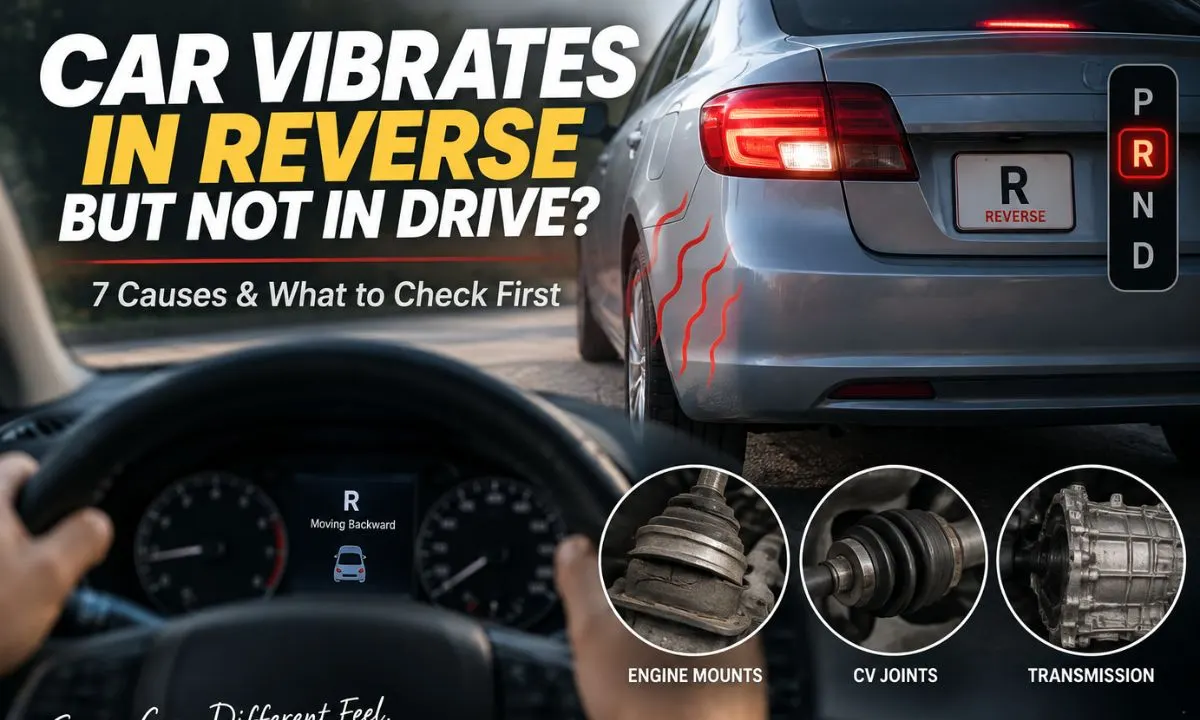
If your car vibrates in Reverse but not in Drive, that difference is one of the most useful clues you can give a mechanic.
Reverse loads the engine, transmission and drivetrain differently from a forward gear. A component that seems perfectly normal in Park, Neutral or Drive can move, twist or make contact when the direction of torque changes.
In many cases, worn engine or transmission mounts are the first components worth checking, especially when the vehicle vibrates while completely stopped with your foot on the brake. But mounts are not the only possibility.
A rough-running engine, exhaust contact, worn CV joints, transmission problems or other drivetrain components can produce a similar symptom.
The most important question is not simply, “Why does my car shake in Reverse?”
It is:
Does it vibrate while stopped in Reverse, or only while the vehicle is actually moving backward?
That single distinction can dramatically narrow the diagnosis.
Quick Answer: Why Does My Car Vibrate in Reverse but Not Drive?
If your vehicle runs smoothly in Park and Drive but develops a noticeable vibration when you select Reverse, the most likely causes include:
- Worn engine mounts
- Worn transmission mounts
- Rough idle or engine misfire under load
- Exhaust or heat shield contacting the body
- Worn CV joints or drive axles
- Transmission or reverse-gear engagement problems
- Drivetrain, brake or suspension problems that occur only while moving backward
If the vibration begins the moment you shift into Reverse while the car is still stationary, start with the engine and transmission mounts.
If it happens only after the car begins rolling backward, pay more attention to CV joints, axles, wheels, brakes, suspension and drivetrain components.
For more vehicle troubleshooting guides, visit Diary OK’s Car Problems & Diagnostics section.
What the Type of Vibration Can Tell You
Before replacing anything, identify exactly how the vibration behaves.
| What you notice | Areas worth checking first |
|---|---|
| Vibrates while stopped in Reverse | Engine/transmission mounts, idle quality |
| Strong vibration immediately when Reverse engages | Mounts, transmission engagement |
| Clunk followed by vibration | Broken/collapsed mount, driveline play |
| Vibration only while backing up | CV joints, axle, brakes, wheels |
| Worse while reversing with steering turned | CV joint/axle |
| Worse with A/C on | Weak mount, low/rough idle |
| RPM drops and engine shakes | Engine running problem |
| Engine sounds smooth but cabin shakes | Mounts or exhaust contact |
| Vibration plus grinding | Transmission, brakes or driveline |
| Delayed Reverse engagement then hard bump | Transmission requires diagnosis |
| Only happens when engine is cold | Idle strategy, mount behavior, engine issue |
| Only happens reversing uphill | Mount/drivetrain load becomes more important |
This table is a starting point rather than a final diagnosis.
The goal is to use the behavior of the vehicle to determine which system deserves inspection first.
Why Can a Car Vibrate in Reverse but Not Drive?
The engine and transmission are not rigidly bolted to the body of the car.
They are supported by mounts that allow controlled movement while absorbing vibration.
When the engine produces torque, the entire powertrain tries to rotate slightly in the opposite direction. The mounts control that movement.
When you select Reverse, the direction of drivetrain loading changes.
A mount that handles forward torque normally may move differently when torque is applied in the opposite direction.
That is why a vehicle can feel smooth in Drive but suddenly shake when placed in Reverse.
The symptom does not automatically mean the transmission is failing.
In fact, several manufacturer-documented cases of reverse-only vibration have involved the engine mounting system rather than an internal transmission failure.
1. Worn Engine Mounts
Engine mounts are one of the first things to investigate when a vehicle vibrates only in Reverse.
Their job is more complicated than simply holding the engine in place.
They must:
- Support the weight of the engine
- Control engine movement during acceleration
- Control movement when shifting gears
- Absorb normal engine vibration
- Prevent excessive vibration from entering the cabin
Most mounts use rubber, hydraulic fluid or a combination of materials to isolate vibration.
As the rubber ages, it can crack, separate or collapse. Hydraulic mounts can also lose their ability to control movement.
A damaged mount may still control the engine reasonably well in one direction while allowing excessive movement in another.
Reverse exposes that weakness.
Signs that point toward an engine mount
A damaged engine mount becomes more likely if:
- The vibration starts immediately after selecting Reverse
- The vehicle is stationary when it happens
- Drive feels noticeably smoother
- The steering wheel or dashboard shakes
- You feel vibration through the seat or floor
- There is a thump when shifting between Drive and Reverse
- The engine feels smooth in Neutral
- The vibration becomes stronger with the A/C running
- The vehicle has higher mileage
A mount does not always need to be completely broken to cause this problem.
Even a partially collapsed mount can change the engine’s position enough to transmit vibration directly into the body.
Real Documented Case: Volkswagen Jetta Vibration in Reverse
There is a particularly interesting real-world example involving Volkswagen.
Certain 2009–2017 Volkswagen Jetta vehicles were documented with excessive vibration at idle or during slow parking-lot maneuvers while the transmission was in Reverse.
The unusual part was the cause.
It was not necessarily a destroyed transmission.
Small stones or other debris could become trapped in the torsional engine mount.
The trapped material restricted the mount’s normal movement and could make it contact the subframe. Once that happened, normal engine vibration could be transmitted more directly into the vehicle.
The recommended inspection involved checking the engine-mount area for trapped debris.
This is an excellent example of why a reverse-only vibration should be diagnosed before expensive components are replaced.
A symptom that feels like a major drivetrain failure can sometimes come from something much simpler.
Diary OK also covers other unusual symptoms, including our guide explaining why some cars smell like crayons when they get hot.
Another Documented Example: Toyota Venza
A similar pattern has existed on certain Toyota vehicles.
Some 2009 four-cylinder AWD Toyota Venza models developed an engine idle vibration specifically while the transaxle was in Reverse.
The repair information focused on the engine mounting system and a support spacer rather than telling technicians to replace the transmission.
Again, this illustrates an important diagnostic principle:
Reverse-only vibration does not automatically equal transmission failure.
The mount system should often be investigated first.
2. Worn Transmission Mount
The transmission also needs support and vibration isolation.
Depending on the vehicle, what people call an “engine mount problem” may actually involve the transmission mount or torque mount.
The principle is similar.
When Reverse engages, torque loads the powertrain in a different direction. A weak transmission mount can allow the transmission and engine assembly to move farther than intended.
That movement may create:
- Vibration
- A thump
- A clunk
- A deep rumbling sensation
- Contact between components
- Increased cabin vibration
How a transmission mount problem can feel
Imagine the engine is running normally.
In Park:
Smooth.
Shift into Drive:
Still reasonably smooth.
Shift into Reverse:
The whole body begins buzzing.
If engine RPM remains relatively stable while the vibration suddenly enters the cabin, a mount becomes a stronger possibility.
If the engine itself begins stumbling and RPM drops sharply, the diagnosis begins moving toward an engine-running problem instead.
Engine Mount vs. Transmission Mount: How Can You Tell?
You cannot always determine which mount is bad from the driver’s seat.
Vehicles can have several mounts arranged in different positions.
However, these clues help:
More likely a mount problem
- Engine sounds normal
- RPM stays fairly stable
- Vibration transfers into body
- Thump when changing gear direction
- Vibration changes dramatically between Drive and Reverse
More likely an engine-running problem
- RPM fluctuates
- Engine sounds uneven
- Check engine light appears
- Misfire can be heard or felt
- Vehicle nearly stalls
- Problem also exists in other gears
A proper inspection should evaluate the entire mounting system rather than replacing whichever mount is easiest to reach.
3. Rough Idle That Becomes Obvious Under Reverse Load
Sometimes the mounts are doing their job.
The engine itself is not running smoothly.
An engine can seem acceptable in Park or Neutral because there is relatively little load on it.
Once the transmission is placed in gear, the engine must work slightly harder to maintain idle speed.
Reverse may expose a marginal engine-running problem that was difficult to notice before.
Possible causes include:
- Ignition misfire
- Worn spark plugs
- Ignition coil problems
- Vacuum leaks
- Dirty throttle body
- Fuel-delivery problems
- Injector issues
- Incorrect air-fuel mixture
- Low idle speed
- Sensor problems
Watch the RPM
One of the easiest clues is the tachometer.
When Reverse is selected, a slight RPM change can be normal.
What is more suspicious is a significant RPM drop accompanied by shaking, stumbling or near-stalling.
For example:
Park: 750 RPM and smooth
Drive: 700 RPM and reasonably smooth
Reverse: RPM falls dramatically and engine shakes
That deserves engine diagnosis rather than automatically replacing mounts.
Can a Misfire Be Worse in Reverse?
Yes.
A weak cylinder may be much less noticeable when the engine has almost no load.
Placing the transmission into gear increases engine load at idle.
That additional load can expose an ignition, fuel or compression problem.
If you also have:
- Check engine light
- Flashing check engine light
- Rough acceleration
- Poor fuel economy
- Loss of power
- Difficult starting
the vibration may be part of a broader engine issue.
A flashing check engine light deserves particular attention because active misfires can damage the catalytic converter.
4. Exhaust System or Heat Shield Contact
This cause is easy to overlook.
The engine and exhaust system move slightly when torque changes direction.
If an engine mount is weak—or if the exhaust was installed with insufficient clearance—the exhaust pipe, muffler, catalytic converter or heat shield may touch the body only when Reverse is selected.
That contact can create a surprisingly strong vibration.
What exhaust contact may feel like
It may produce:
- Buzzing through the floor
- Metallic vibration
- Rattle at a specific RPM
- Deep droning noise
- Vibration only while stationary in Reverse
This is particularly important because the engine itself may run perfectly.
The problem is simply that vibration now has a direct path into the vehicle body.
Why Reverse triggers it
When torque moves the engine in the reverse direction, the exhaust system connected to the engine also shifts slightly.
A clearance that is adequate in Drive may disappear in Reverse.
The exhaust then touches:
- Subframe
- Crossmember
- Heat shield
- Body panel
- Suspension component
and the cabin begins vibrating.
How to Check for Exhaust Contact
With the vehicle turned off and fully cooled, inspect visible exhaust clearances.
Look for:
- Shiny contact marks
- Scratches
- Damaged exhaust hangers
- Bent heat shields
- Missing rubber hangers
- Areas where metal components nearly touch
Never crawl under a vehicle supported only by a jack.
Proper lifting equipment and support stands are essential.
5. CV Joint or Drive Axle Problems
There is an important distinction here.
If the car vibrates while completely stopped in Reverse, a CV joint is less likely to be the primary cause because the axle is not rotating.
If the car becomes smooth when stopped but starts vibrating as soon as you actually back up, the axle and CV joints become much more relevant.
CV joints allow power to travel through the drive axles while the suspension and steering move.
A worn joint may behave differently depending on:
- Vehicle direction
- Steering angle
- Suspension position
- Torque direction
- Acceleration load
Signs of a possible CV-joint problem
Look for:
- Clicking while turning
- Vibration while reversing with steering turned
- Shudder while accelerating backward
- Torn CV boot
- Grease thrown around the inside of the wheel
- Clunk when changing direction
If vibration is much stronger when reversing out of a parking space with the steering wheel turned, an outer CV joint deserves attention.
If the vibration occurs during straight-line acceleration, an inner joint or axle can become more relevant.
Straight Reverse vs. Turning Reverse
This is a very useful test.
Smooth reversing straight, vibration when turning
Think more about:
- CV joints
- Axles
- Wheel/suspension geometry
Vibrates even while completely stopped
Think more about:
- Engine mounts
- Transmission mounts
- Engine idle
- Exhaust contact
Vibrates while moving backward regardless of steering angle
Investigate:
- Axles
- Drivetrain
- Wheels
- Brakes
- Transmission
The more precisely you describe the condition, the less likely you are to replace unnecessary parts.
6. Transmission Engagement or Internal Transmission Problem
The transmission should not be ignored completely.
Reverse uses transmission components differently from the forward gears.
An internal problem can therefore appear primarily—or sometimes initially—in Reverse.
Possible clues include:
- Delay before Reverse engages
- Hard engagement
- Sudden bang
- Grinding
- Vehicle barely moves backward
- Engine revs but vehicle does not reverse normally
- Transmission warning message
- Fluid leak
- Burnt-smelling transmission fluid where applicable
- Vibration accompanied by slipping
A transmission problem becomes more concerning when the symptom involves engagement quality, not simply vibration.
Example
You select Reverse.
Nothing happens for two seconds.
Then:
BANG — Reverse engages and the car shakes.
That pattern is different from:
You select Reverse.
The gear engages immediately and smoothly.
The engine remains at a stable RPM, but the cabin vibrates.
The second pattern points more strongly toward mounts or physical contact.
The first deserves transmission diagnosis.
Does Low Transmission Fluid Cause Vibration in Reverse?
It can contribute to abnormal transmission operation on vehicles where fluid level and hydraulic pressure are relevant, but do not assume low fluid is the cause.
Modern transmission fluid-checking procedures vary dramatically.
Some vehicles have dipsticks.
Others require:
- A specific transmission temperature
- Vehicle level on a lift
- A fill/check plug
- A scan tool
- A precise manufacturer procedure
Do not randomly add transmission fluid.
Too much fluid can also create problems, and using the wrong specification can damage the transmission.
Always follow the manufacturer’s procedure for your specific vehicle.
7. Brakes, Suspension, Wheel or Drivetrain Problems While Moving Backward
If your car does not vibrate when stationary in Reverse but shakes as it actually moves backward, widen the diagnosis beyond the engine and transmission mounts.
Potential areas include:
- Brake components
- Wheel or tire issues
- Suspension bushings
- Axles
- CV joints
- Driveshaft
- Universal joints
- Differential components
This is especially true on:
- Rear-wheel-drive vehicles
- AWD vehicles
- 4WD trucks
- SUVs with multiple driveshaft components
Does the vibration match vehicle speed?
Ask yourself:
Does the vibration get faster as the vehicle moves faster backward?
If yes, think more about rotating components.
Engine-mount vibration is generally tied more closely to engine speed and load than road speed.
Wheel, axle or driveshaft vibration usually changes with vehicle movement.
The Most Important Diagnostic Test: Does It Shake Before the Car Moves?
This is perhaps the single most useful question in the entire article.
Start the vehicle.
Keep your foot firmly on the brake.
Select Reverse.
Do not move.
If it already vibrates
Focus first on:
- Engine mounts
- Transmission mounts
- Engine idle quality
- Exhaust contact
- Transmission engagement
If it remains smooth
But vibration begins when you release the brake and roll backward:
Focus more on:
- CV joints
- Axles
- Brakes
- Wheels
- Driveshaft
- Suspension
- Differential/drivetrain
This simple distinction can save a tremendous amount of diagnostic time.
Does the Car Shake in Reverse With the A/C On?
Try comparing the symptom with the air conditioner on and off.
A/C operation adds additional load to the engine through the compressor or electrical system depending on vehicle design.
If Reverse vibration becomes dramatically worse with the A/C running, that can expose:
- Weak engine mount
- Low idle condition
- Engine running problem
- A/C compressor-related load issue
This does not mean the A/C system itself is necessarily broken.
The additional load may simply make an existing problem easier to feel.
Does It Vibrate More When the Engine Is Cold?
Temperature can also be a useful clue.
Cold engines often run at different idle speeds and operating strategies than fully warmed engines.
If the vibration is strongest for the first few minutes and disappears after the engine reaches operating temperature, investigate:
- Cold idle quality
- Engine mounts
- Ignition condition
- Fuel mixture
- Engine-control issues
If the vibration becomes worse only after the vehicle is hot, consider how heat affects mounts, fluids and drivetrain components.
The key is consistency.
Write down exactly when it happens.
Does Your Car Vibrate in Reverse Uphill?
Reversing uphill increases drivetrain load.
A worn mount that causes only a mild vibration on level ground may become much more noticeable when reversing up a driveway.
The same applies to CV joints, axles and other drivetrain components.
If the symptom happens primarily when:
- Reversing uphill
- Reversing with steering turned
- Carrying a heavy load
- Towing
- Backing over an incline
tell the technician.
Load-dependent symptoms can be extremely valuable during diagnosis.
Reverse Vibration by Symptom: Quick Diagnosis Table
| Symptom | Most likely area to investigate |
|---|---|
| Vibrates in Reverse while stopped | Engine/transmission mounts |
| RPM drops and shakes | Engine idle/misfire |
| Clunk when Reverse engages | Mount/drivetrain play |
| Delayed Reverse then hard engagement | Transmission |
| Vibration while reversing and turning | CV joint/axle |
| Metallic buzz in Reverse | Exhaust/heat shield contact |
| Worse with A/C | Weak mount or idle issue |
| Only moving backward | Axle/brake/wheel/drivetrain |
| Worse backing uphill | Mount or drivetrain under load |
| Grinding in Reverse | Transmission/brakes/driveline |
| Check engine light + shaking | Engine diagnostic issue |
A Safe Step-by-Step Check You Can Do Before Visiting a Mechanic
You do not need to begin by buying parts.
Start by gathering evidence.
Step 1: Compare Park, Neutral, Drive and Reverse
On level ground with the parking brake properly applied and your foot firmly on the brake, compare how the vehicle feels in:
Park → Neutral → Drive → Reverse
Pay attention to:
- RPM
- Noise
- Steering wheel vibration
- Seat vibration
- Dashboard vibration
Do not repeatedly shift rapidly between gears.
Allow each gear to engage normally.
Step 2: Determine Whether Movement Matters
Does it vibrate while stationary?
Or only when actually backing up?
This separates engine-load problems from many rotating drivetrain problems.
Step 3: Turn the A/C Off
Compare vibration with:
A/C ON
and
A/C OFF
A significant difference can reveal a marginal idle or mounting problem.
Step 4: Listen for a Clunk
A single heavy thud when changing from Drive to Reverse can indicate excessive drivetrain movement.
Repeated clicking while reversing and turning points in another direction.
Different noises mean different things.
Step 5: Watch the Tachometer
Does RPM remain relatively steady?
Or does it fall sharply when Reverse engages?
Stable RPM with strong body vibration can support the mount/contact theory.
Unstable RPM suggests investigating engine operation.
Step 6: Check for Warning Lights
Scan the instrument cluster.
A check engine light, transmission warning or other fault message changes the diagnosis.
Even without a warning light, an OBD-II scan can sometimes reveal pending or stored diagnostic trouble codes.
Step 7: Inspect What Is Safely Visible
With the engine turned off, inspect visible areas for:
- Cracked mount rubber
- Fluid leaking from hydraulic mounts
- Torn CV boots
- Grease around wheels
- Damaged exhaust hangers
- Loose heat shields
- Fluid leaks
Do not place yourself under a running vehicle.
Do not stand directly in front of or behind a vehicle while someone shifts gears.
Can You Test Engine Mounts at Home?
You can perform basic observations, but a proper mount diagnosis may require a technician.
Engine movement must be evaluated carefully because some movement is normal.
The amount considered acceptable differs by vehicle and mount design.
A professional can inspect:
- Rubber separation
- Hydraulic leakage
- Mount collapse
- Excessive powertrain movement
- Mount-to-body contact
- Exhaust clearance under load
Avoid using a single Internet measurement such as “the engine should never move more than X inches” for every vehicle.
Different powertrains behave differently.
Why Replacing All the Mounts Immediately May Be a Mistake
A common diagnostic mistake is:
Car shakes → mounts must be bad → replace every mount.
Sometimes that works.
Sometimes it wastes hundreds or thousands of dollars.
Remember the documented Volkswagen example: debris trapped in the mount area could create the symptom.
Other possibilities include:
- Mount bracket position
- Exhaust contact
- Rough idle
- Transmission issue
- CV joint
Diagnosis should come before parts replacement.
This same principle applies throughout automotive repair. Our article about automotive engineering and diagnostic testing explains why inspection, data and testing are more reliable than simply replacing parts until a symptom disappears.
Honda Civic Shakes in Reverse: Are Engine Mounts Common?
Some Honda Civic owners have reported a low rumbling or vibration while idling in Reverse associated with worn engine mounts.
That does not mean every Civic that shakes in Reverse automatically needs mounts.
Model year, engine, mileage and the exact symptoms matter.
However, on a Civic that:
- Runs smoothly
- Shifts normally
- Vibrates heavily while stopped in Reverse
- Has higher mileage
- Has no significant RPM instability
engine mounts deserve an early inspection.
Honda owners can also browse Diary OK’s Honda vehicle guides and news.
Volkswagen Shakes in Reverse
Volkswagen deserves special attention because of the documented Jetta case discussed earlier.
If you have a Volkswagen that vibrates heavily in Reverse, inspect:
- Engine mounts
- Transmission mount
- Torque mount
- Mount clearances
- Debris near the mounting system
- Exhaust contact
- Engine idle quality
Do not assume the same cause applies to every model.
The engineering of a modern vehicle such as the Volkswagen Amarok differs greatly from an older Jetta, so model-specific diagnosis remains important.
Is It Safe to Drive a Car That Vibrates in Reverse?
A mild vibration does not automatically mean the vehicle is about to fail.
But you should not ignore a new or worsening vibration.
Schedule diagnosis soon if:
- Vibration is becoming stronger
- Engine moves excessively
- There is a clunk during gear changes
- Reverse engagement is delayed
- You notice fluid leaks
- Check engine light is on
- Transmission warning appears
Stop driving and arrange appropriate inspection if you experience:
- Violent shaking
- Grinding
- Loss of vehicle control
- Serious transmission slipping
- Flashing check engine light with severe misfire
- Burning smell
- Smoke
- Major fluid leak
- Vehicle unexpectedly lunging when Reverse engages
Safety matters more than finishing the trip.
Can Bad Motor Mounts Damage Other Parts?
A severely worn mount can allow excessive powertrain movement.
Over time, this can place additional stress on components such as:
- Exhaust connections
- Hoses
- Wiring
- Axles
- Other mounts
That does not mean a weak mount will immediately destroy nearby components.
But allowing excessive movement to continue indefinitely is not ideal.
Have the cause diagnosed before the vibration becomes significantly worse.
Can an Engine Mount Be Bad Without Looking Broken?
Yes.
Not every failed mount is visibly torn.
Some hydraulic mounts fail internally.
Others collapse or lose stiffness while still appearing relatively intact from above.
The mount may also be difficult to inspect without supporting or moving the powertrain appropriately.
This is another reason a visual inspection alone does not always confirm the diagnosis.
Can Bad Spark Plugs Make a Car Shake in Reverse?
Yes, indirectly.
Worn spark plugs can contribute to a weak or intermittent misfire.
The engine may seem relatively smooth when unloaded in Park but shake once Reverse increases the load at idle.
However, a spark-plug problem would often produce other symptoms as well, such as:
- Rough acceleration
- Poor fuel economy
- Check engine light
- Misfire codes
- Loss of power
- Hard starting
Do not replace spark plugs solely because the car shakes in Reverse unless the vehicle’s maintenance schedule or diagnostic evidence supports it.
Could Dirty Engine Oil Cause Reverse-Only Vibration?
Ordinary overdue engine oil is not one of the first explanations for a vibration that occurs only in Reverse.
Correct oil and regular maintenance remain important for engine durability, but a direction-specific vibration points more strongly toward mounting, loading or drivetrain behavior.
If your vehicle is due for service, Diary OK also has a guide explaining how much an oil change can cost and what affects the price.
Do not confuse routine maintenance with diagnosis.
Changing oil is not a reliable repair for a reverse-only vibration unless there is a separate oil-related problem.
Is Reverse Vibration a Sign My Transmission Is Dying?
Not necessarily.
This is one of the biggest fears drivers have when the symptom begins.
If Reverse:
- Engages promptly
- Does not slip
- Does not grind
- Moves the vehicle normally
- Produces no warning codes
- And the only symptom is vibration while stationary
the transmission may not be the first suspect.
Engine and transmission mounts deserve consideration.
Transmission problems become more concerning when the vibration appears together with:
- Delayed engagement
- Slipping
- Harsh gear engagement
- Abnormal transmission noises
- Fluid leaks
- Transmission warning lights
- Loss of Reverse
Diagnosis should be based on the complete symptom pattern.
What If the Car Shakes in Both Drive and Reverse?
That broadens the diagnosis.
If the vehicle vibrates in both gears while stopped but becomes smooth in Park or Neutral, possible causes include:
- Engine mounts
- Transmission mount
- Low or unstable idle
- Engine misfire
- Exhaust contact
If it also vibrates in Park and Neutral, engine performance itself becomes more important.
The more gears in which the symptom appears, the less “Reverse-specific” the problem becomes.
What If the Car Only Shakes When Reversing and Turning?
This is a different pattern.
If the car is smooth while stopped in Reverse but begins vibrating as you reverse while turning the steering wheel, inspect:
- CV joints
- Drive axles
- Suspension
- Wheel/tire area
Listen carefully for clicking.
A repeated click-click-click while turning is very different from a steady cabin vibration while stationary.
What If It Shakes Only When Backing Uphill?
Reversing uphill places more torque through the drivetrain.
That additional load can expose:
- Weak mounts
- CV-joint wear
- Drivetrain play
- Transmission problems
Tell the technician that the incline matters.
A mechanic testing only on flat ground may not immediately reproduce the condition.
How a Mechanic May Diagnose Reverse-Only Vibration
A good diagnostic process may include:
- Reproducing the complaint
- Comparing Park, Neutral, Drive and Reverse
- Observing engine RPM and smoothness
- Checking diagnostic trouble codes
- Inspecting engine and transmission mounts
- Checking exhaust clearances
- Inspecting CV joints and axles
- Evaluating transmission engagement
- Testing the vehicle while reversing straight and turning
- Checking manufacturer technical information for model-specific problems
That final step is important.
The Volkswagen and Toyota examples show that some reverse-vibration problems have known model-specific causes.
A generic diagnosis cannot replace vehicle-specific technical information.
What Should You Tell the Mechanic?
Instead of saying:
“My car shakes.”
Give details.
For example:
“The car is smooth in Park and Neutral. Drive is almost completely smooth. When I select Reverse with my foot on the brake, the steering wheel and seat start vibrating immediately. RPM stays stable. It gets worse with the A/C on.”
That description contains several diagnostic clues.
Also provide:
- Year
- Make
- Model
- Engine
- Transmission type
- Mileage
- Whether engine is hot or cold
- Whether A/C changes the vibration
- Whether steering position changes it
- Any warning lights
- Any recent repairs
The more reproducible the symptom is, the easier it becomes to diagnose correctly.
Frequently Asked Questions
Why does my car vibrate only when I put it in Reverse?
Reverse changes the direction of torque through the powertrain. A weak engine or transmission mount may control the drivetrain normally in forward gears but allow more vibration when loaded in Reverse. Rough idle, exhaust contact, CV joints and transmission problems are other possibilities.
Are bad motor mounts the most likely cause?
They are one of the first things worth checking when the vehicle vibrates while stationary in Reverse but runs smoothly in Park, Neutral or Drive. They are not the only possible cause.
Why does my car shake in Reverse but stop when I start moving?
That pattern can point toward an idle-load or mounting problem. Once engine RPM changes or the drivetrain load changes while moving, the vibration may become less noticeable.
Why does my car vibrate when reversing and turning?
CV joints and drive axles deserve more attention when vibration occurs only while the vehicle is moving backward, especially with the steering turned.
Can a bad transmission mount cause vibration only in Reverse?
Yes. The transmission and engine react differently when torque direction changes. A weak mount can allow excessive movement specifically under reverse load.
Can transmission problems cause reverse-only vibration?
Yes, particularly when the vibration is accompanied by delayed Reverse engagement, slipping, grinding, hard engagement or loss of Reverse. Vibration alone does not prove the transmission is failing.
Why does the vibration get worse with the A/C on?
The A/C system adds load to the engine. That additional load can make a weak mount, low idle or engine-running problem more noticeable.
Yes. If the engine has an ignition, fuel or air-management problem, selecting Reverse can increase load enough to make the roughness more obvious. Scan for diagnostic trouble codes when a warning light is present.
Is it normal for a car to vibrate slightly in Reverse?
A small change in sound or vibration can be normal because Reverse changes drivetrain load. A strong, new or worsening vibration should be investigated.
Can I keep driving with a bad engine mount?
A mildly worn mount may not create an immediate emergency, but excessive powertrain movement can worsen and place stress on other components. Have a new or significant vibration diagnosed rather than ignoring it.
Final Answer: What Should You Check First?
If your car vibrates in Reverse but not in Drive, start by determining whether it shakes before the vehicle moves.
If it vibrates while completely stationary in Reverse and the engine RPM remains stable, engine and transmission mounts are among the first components worth inspecting.
If the engine RPM drops, the engine stumbles or a check engine light appears, investigate engine idle and misfire problems.
If vibration begins only when the car actually moves backward—especially while turning—look more closely at the CV joints, axles, wheels, brakes and drivetrain.
And if Reverse engages late, slips, grinds or produces a severe bang, the transmission requires closer attention.
The important lesson is simple:
Do not replace the transmission just because the car shakes in Reverse.
Manufacturer-documented examples show that reverse-only vibration can come from something as specific as an engine mounting issue—or even debris interfering with a mount.
Diagnose the pattern first.
Replace parts second.
Continue exploring Diary OK’s automotive guides and vehicle troubleshooting content as we build a complete library for diagnosing common car problems.