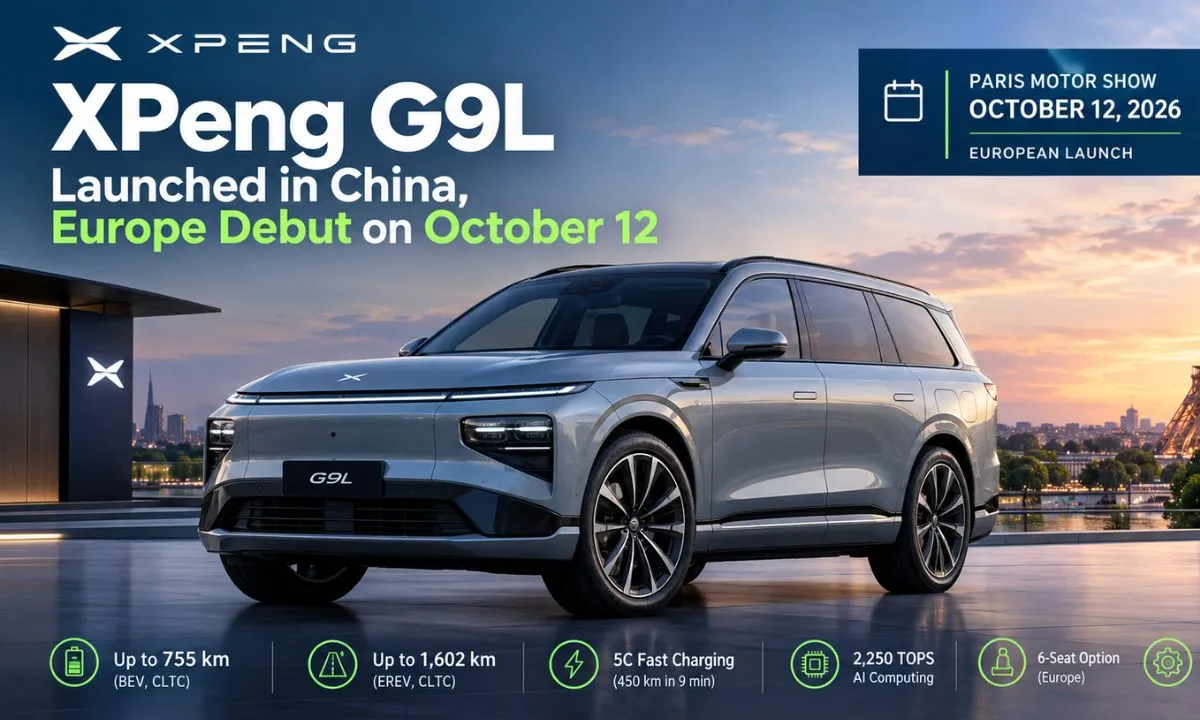
XPeng has officially launched the G9L, its new large flagship SUV, in China with prices starting at 231,800 yuan under a limited-time launch offer, while preparing the vehicle for its international debut at the 2026 Paris Motor Show on October 12.
The G9L is one of XPeng’s most ambitious vehicles yet.
It is larger than the current G9, available with either a fully electric drivetrain or an extended-range electric powertrain, rides on an 800-volt architecture and can be equipped with as much as 2,250 TOPS of onboard AI computing power.
But the international story is arguably even more important.
XPeng says the G9L was developed for 64 global markets, tested for more than 6.74 million kilometers across 26 countries and will eventually be produced not only in Guangzhou, China, but also at Magna’s manufacturing facility in Graz, Austria.
That makes the G9L much more than another premium SUV created primarily for China’s rapidly growing EV market.
It is part of XPeng’s attempt to become a serious global competitor to established European, American and Asian automakers.
XPeng G9L: The Most Important Facts
Here is the essential information currently confirmed.
| XPeng G9L | Current information |
|---|---|
| China launch date | September 17, 2026 |
| Europe/global debut | October 12, 2026 |
| Location | Paris Motor Show |
| China launch price | From 231,800 yuan limited-time |
| Official guide price | From 241,800 yuan |
| Powertrains | BEV and range-extended EV |
| Maximum BEV range | Up to 755 km CLTC |
| EREV electric-only range | Up to 435 km CLTC |
| EREV combined range | Up to 1,602 km CLTC |
| Electrical platform | 800 volts |
| Charging | 5C ultra-fast charging |
| Claimed charging gain | Up to 450 km CLTC in 9 minutes |
| Length | 5,120 mm |
| Wheelbase | 3,100 mm |
| China seating | Five seats |
| European configuration shown | Six seats |
| Rear-wheel steering | Standard in China |
| Air suspension | Dual-chamber |
| Maximum AI computing | 2,250 TOPS |
| Planned global reach | 64 countries and regions |
| European production | Graz, Austria |
XPeng officially describes the G9L as its next-generation AI flagship SUV and has confirmed that its international presentation will take place at the Paris Motor Show.
How Much Does the XPeng G9L Cost?
Pricing is one of the most striking aspects of the G9L.
XPeng introduced the model in China across six versions with official guide prices running from approximately 241,800 yuan to 319,800 yuan.
For the launch period, XPeng is applying a 10,000-yuan benefit, reducing the effective starting price to:
231,800 yuan
and the most expensive configuration to:
309,800 yuan.
That means the entry-level G9L begins at roughly the mid-$30,000 range when Chinese pricing is converted directly into U.S. dollars, although a currency conversion should not be interpreted as a future U.S. or European retail price.
Import taxes, VAT, local equipment, transportation costs, homologation and market-specific pricing can make European versions significantly more expensive.
XPeng G9L China Price by Version
The Chinese lineup currently consists of six configurations.
Battery-electric versions
702 RWD Max
Limited-time price:
231,800 yuan
This is the entry point into the G9L range and uses rear-wheel drive.
660 AWD Ultra SE
Limited-time price:
249,800 yuan
This adds all-wheel drive and more advanced equipment.
660 AWD Ultra
Limited-time price:
279,800 yuan
The Ultra increases technology and AI capability.
755 AWD Ultra Flagship
Limited-time price:
309,800 yuan
This is the longest-range battery-electric version and the most expensive BEV in the current Chinese lineup.
Extended-range versions
XPeng also sells two 1602 range-extender variants.
1602 AWD Ultra SE
Limited-time price:
249,800 yuan
1602 AWD Ultra Flagship
Limited-time price:
299,800 yuan
Interestingly, the Ultra SE versions of the BEV and range-extender models are priced identically in China.
That gives buyers a genuine choice between maximum electric purity and much longer total driving range without a significant entry-price penalty.
Why Is It Called the XPeng G9L?
The G9L sits above the existing XPeng G9 and becomes one of the company’s flagship SUVs.
XPeng’s European communications explain that the “L” represents Luxury, emphasizing the model’s more premium positioning and additional size.
The G9L measures:
5,120 mm long
with a:
3,100 mm wheelbase.
That makes it a substantial luxury SUV and notably larger than the existing G9.
XPeng says the proportions were chosen to provide significant passenger space without sacrificing maneuverability.
Rear-wheel steering is a major part of that strategy.
XPeng G9L BEV vs. Range Extender: What’s the Difference?
XPeng is following an increasingly important trend in China’s auto industry by offering the G9L with two fundamentally different electrified powertrains.
Buyers can choose:
BEV — Battery Electric Vehicle
or:
EREV — Extended-Range Electric Vehicle
Both use electric motors to move the vehicle, but the way they obtain energy differs.
Fully Electric XPeng G9L
The battery-electric range consists of versions rated at:
660 km CLTC
702 km CLTC
and up to:
755 km CLTC
depending on configuration.
The 755 AWD Ultra Flagship therefore carries the longest advertised battery-electric range in the Chinese lineup.
But there is an important point for European buyers:
CLTC range is not WLTP range.
China’s CLTC test cycle generally produces different—and often higher—range figures than Europe’s WLTP procedure.
Therefore, a European G9L should not automatically be described as having 755 km of WLTP range.
We will need to wait for XPeng’s European specifications.
XPeng G9L Extended-Range Version
The other option is considerably more unusual for buyers accustomed to conventional European EVs.
XPeng’s extended-range G9L pairs a large battery with a gasoline engine used to generate electricity.
The vehicle still relies on electric propulsion, while the combustion engine works as an onboard energy source when necessary.
The range-extender version uses a:
63.3-kWh battery
along with a:
60-liter fuel tank.
XPeng claims as much as:
435 km of pure-electric CLTC range
and:
1,602 km of combined CLTC range.
That is almost 1,000 miles of claimed combined range under China’s test cycle.
Why XPeng Is Offering Both BEV and EREV
The dual-powertrain strategy solves two different problems.
A pure EV is ideal for buyers who:
- Have reliable charging
- Want zero gasoline use
- Primarily drive in developed charging regions
- Prefer a simpler electric drivetrain
An extended-range EV can appeal to buyers who:
- Frequently make long trips
- Travel through areas with limited fast charging
- Want electric driving for everyday use
- Still want a liquid-fuel backup for long-distance travel
This technology has become increasingly popular among Chinese manufacturers.
For consumers, it essentially tries to combine much of the driving experience of an EV with some of the convenience associated with gasoline refueling.
The G9L therefore enters the global market at an interesting moment when automakers are debating whether the future should be fully electric, hybrid or multi-powertrain.
Diary OK is following that broader transition through our Autos and Vehicles coverage.
The XPeng G9L Uses an 800-Volt Architecture
Every Chinese G9L variant uses an 800-volt electrical architecture.
This is becoming an increasingly important feature in modern premium EVs.
Higher-voltage platforms can improve charging performance and reduce electrical losses when combined with appropriate battery cells, cooling systems and charging infrastructure.
XPeng goes further by pairing the platform with a 5C-capable battery system.
According to the company, compatible charging can add as much as:
450 km of CLTC-rated range in nine minutes.
Again, the exact kilometers shown on a European dashboard after nine minutes will depend on the final WLTP specification, charging conditions, battery temperature and charger output.
But the underlying charging capability is one of the G9L’s biggest technical selling points.
What Does 5C Charging Mean?
The “C” rating describes battery charging power relative to battery capacity.
In simplified terms, a theoretically ideal 1C charge rate corresponds to charging energy equivalent to the battery’s capacity in roughly one hour.
A 5C-capable battery can accept dramatically greater peak power under the appropriate conditions.
In reality, EV batteries cannot maintain maximum charging power from 0% to 100%.
Charging speed usually decreases as battery state of charge rises.
That means the number buyers should eventually watch is not only peak charging power but also:
the complete charging curve.
A vehicle that sustains strong charging power over a broad percentage range can sometimes be more useful than one with a spectacular peak number that lasts only briefly.
XPeng Claims Up to 450 km Added in Nine Minutes
XPeng’s headline charging claim is:
9 minutes → up to 450 km of added CLTC range.
That is an impressive marketing figure.
But European buyers should wait for an equivalent test using the European G9L and locally available charging infrastructure.
Real-world charging performance depends on:
- Battery temperature
- Starting state of charge
- Charger output
- Charging-station voltage
- Battery preconditioning
- Ambient temperature
- Software limits
The Paris launch should give us a much better idea of how XPeng intends to position the G9L’s charging performance in Europe.
Performance: How Fast Is the XPeng G9L?
Despite its considerable size, the G9L is not slow.
XPeng’s Chinese specifications indicate that the AWD battery-electric version can accelerate from:
0–100 km/h in approximately 4.45 seconds.
The range-extended AWD version is rated at approximately:
4.95 seconds.
For a 5.12-meter luxury family SUV, both figures are substantial.
The G9L is therefore designed not only around comfort and range but also around the high acceleration levels consumers increasingly expect from premium electric vehicles.
Rear-Wheel Steering Could Be One of Its Best Everyday Features
One of the most useful technologies in the G9L may have nothing to do with maximum acceleration or AI.
It is rear-wheel steering.
XPeng says the system helps the large SUV achieve a minimum turning radius of approximately:
5.4 meters.
That matters because the G9L is more than five meters long.
At lower speeds, steering the rear wheels in the opposite direction from the front wheels can effectively reduce the vehicle’s turning circle.
At higher speeds, rear steering can also contribute to stability depending on how the system is calibrated.
In crowded European cities, that technology may be considerably more useful than another few tenths of a second in acceleration.
Dual-Chamber Air Suspension Comes Standard in China
XPeng has equipped the Chinese G9L range with a sophisticated chassis package.
It includes:
- Rear-wheel steering
- Dual-chamber air suspension
- Adaptive variable damping
- AI-integrated chassis control
The goal is to make a large SUV feel both comfortable and manageable.
Whether all of this equipment remains standard on every European version is not yet confirmed.
This is precisely why the October 12 launch matters.
Chinese specifications should not automatically be copied onto European price lists.
The Interior Is Designed Like a Technology Lounge
The G9L’s cabin is another area where XPeng is trying to differentiate itself.
The Chinese model includes equipment such as:
88-inch panoramic augmented-reality head-up display
23-speaker audio system
multiple 50-watt wireless charging pads
integrated refrigerator
extensive acoustic glass
and substantial cargo storage.
The enormous HUD is particularly interesting.
Instead of relying only on a traditional instrument cluster, XPeng is using the windshield as a large information surface.
The company is betting that future premium-car interiors will increasingly depend on projected information, AI and software rather than simply adding more physical displays.
An 88-Inch AR Head-Up Display
The 88-inch figure does not mean there is literally an 88-inch television mounted on the dashboard.
It refers to the perceived projection area of the augmented-reality HUD.
The system can place navigation and driving information into the driver’s forward field of view.
The advantage is simple:
the driver can receive useful information without repeatedly looking down at a dashboard screen.
The challenge is execution.
A poorly designed AR display can become distracting.
A good one can make navigation dramatically easier to understand.
XPeng G9L AI: Up to 2,250 TOPS
Artificial intelligence is central to XPeng’s marketing for the G9L.
The SUV uses the company’s internally developed Turing AI chips.
Different trims receive different computing configurations.
The entry-level Max uses a single chip and a lighter version of XPeng’s Vision-Language-Action system.
Higher versions use additional chips.
Top configurations reach:
three Turing chips
and:
2,250 TOPS of advertised computing capability.
That is an enormous headline number.
However, TOPS alone does not determine how capable a driver-assistance system is.
Software quality, sensor data, model architecture, training and regulatory approval matter just as much.
What Is XPeng VLA 2.0?
VLA stands for:
Vision-Language-Action.
XPeng is attempting to build an AI model that can interpret what the vehicle sees, understand context and convert that interpretation into driving decisions.
The company says its upcoming XOS 6.3.0 release increases the onboard model’s parameter count by 3.5 times and significantly improves response speed.
XPeng says the G9L will be one of the first production vehicles to deploy the upgraded system.
The company has also tested localization of its second-generation VLA system in Germany and says it is targeting European regulatory approval for overseas deployment.
That makes the G9L particularly significant for Europe.
The hardware may be ready before every AI-assisted driving feature is legally enabled.
Don’t Confuse AI Capability With Full Self-Driving
This distinction is important.
A vehicle having thousands of TOPS of computing power does not automatically make it autonomous.
Driver-assistance functions depend on regulations and the specific software approved for a given country.
Some functionality available in China may therefore be restricted, delayed or modified in Europe.
XPeng itself has been working on localized validation in Germany and regulatory approval for European deployment.
European G9L buyers should evaluate the features actually enabled at delivery—not only the capability of the hardware installed in the vehicle.
XPeng Says the G9L Was Tested for 6.74 Million Kilometers
The G9L is intended to be a global vehicle from the beginning.
XPeng says development included:
more than three years of testing
across:
26 countries and regions
with total test mileage exceeding:
6.74 million kilometers.
That type of international validation matters because vehicles face dramatically different conditions around the world.
A global SUV must operate reliably in:
- Extreme heat
- Cold temperatures
- High-speed highways
- Dense cities
- Wet climates
- Poor road surfaces
- Different charging networks
- Different traffic regulations
XPeng’s global ambitions therefore required development beyond Chinese roads alone.
192 Crash Tests Before the Global Launch
Safety is another area XPeng is emphasizing heavily.
The company says the G9L completed:
192 crash tests
covering four major safety-testing protocols:
- Euro NCAP
- ANCAP
- C-NCAP
- CIASI
XPeng says those tests covered more than 110 individual test items.
This does not mean the G9L has already officially received final five-star consumer-test ratings from all four organizations.
It means XPeng developed and tested the vehicle against those standards.
That distinction matters.
Actual independent ratings should be evaluated when the relevant safety organizations publish them.
Battery Protection Includes IP68 and IP69K Design
XPeng also claims substantial protection for the battery pack.
The Chinese specifications include both:
IP68
and:
IP69K
protection claims for the battery system.
The company says it has also engineered the battery against impact, compression and thermal risks.
These claims will be especially important as the G9L expands globally because customers increasingly evaluate EVs not only by range and charging speed but also by battery safety.
China Gets Five Seats—Europe Will Be Different
One of the most important differences between the Chinese and European G9L is seating.
The vehicle launched in China as a large five-seat SUV.
XPeng’s European press material, however, has already shown and described a six-seat G9L developed for Europe.
That indicates XPeng is not simply exporting the Chinese specification unchanged.
European customers will receive market-specific configurations.
The full European seating lineup has not yet been finalized publicly in complete detail, so the October event should clarify which versions will actually reach dealerships.
European Specs Should Not Be Assumed From China
This is one of the most important things readers should understand.
The Chinese G9L tells us what the vehicle is technically capable of.
It does not tell us exactly what Europeans will be able to buy.
The European version could differ in:
- Battery configuration
- Rated range
- Charging curve
- Power output
- Seating
- Standard equipment
- Driver-assistance software
- Wheel sizes
- Suspension calibration
- Pricing
- Warranty
- Trim names
October 12 should fill in many of those gaps.
XPeng G9L Europe Launch: October 12, 2026
XPeng has officially confirmed that the global launch event for the G9L will take place on:
October 12, 2026
at the:
Paris Motor Show
in France.
XPeng will be located in Hall 6.
The Paris Motor Show itself runs from October 12 through October 18 at Paris Expo Porte de Versailles.
October 12 is reserved for accredited press, with public access beginning October 13.
That makes the G9L one of the important Chinese premieres to watch at this year’s show.
Does the G9L Go on Sale in 64 Countries on October 12?
Not necessarily.
This is an important distinction.
XPeng says the G9L is planned for 64 countries and regions and that the global launch event will occur on October 12.
That does not automatically mean customers in all 64 markets will be able to order and receive the vehicle on October 12.
Global automotive rollouts normally happen market by market.
Regulatory approval, logistics, local pricing, dealer readiness and production capacity can affect timing.
The October event should reveal more detailed European rollout plans.
XPeng Will Build the G9L in Europe
Perhaps the biggest strategic detail is that the G9L will not rely exclusively on Chinese production.
XPeng says the SUV will also be assembled at Magna’s plant in Graz, Austria.
The G9L is expected to become the fourth XPeng model associated with localized European production there, after the G6, G9 and P7+.
That matters for several reasons.
European manufacturing can help XPeng:
- Reduce transport distances
- Improve supply responsiveness
- Localize production
- Strengthen its European presence
- Potentially mitigate some trade-related pressures
- Respond more quickly to market-specific demand
It also makes XPeng look less like an exporter and more like a manufacturer building a long-term European operation.
Why Magna Matters
Magna is not an unknown contract manufacturer.
Its Graz facility has extensive experience manufacturing vehicles for established global automakers.
XPeng began working with Magna on European localization in 2025.
By using an existing manufacturing partner, XPeng can expand European production without immediately needing to build an entirely new factory from scratch.
The G9L therefore represents another step in a broader localization strategy rather than a one-off experiment.
The G9L Is Part of XPeng’s Global Expansion
XPeng’s international business has become increasingly important.
In its second-quarter 2026 results, XPeng said overseas deliveries exceeded 20,000 vehicles during Q2, while overseas markets contributed roughly 25% of first-half revenue.
The company is therefore no longer treating international sales as a small side business.
The G9L fits directly into that expansion.
It provides XPeng with a larger flagship product that can compete for buyers considering premium electric SUVs from established European and American manufacturers.
XPeng Delivered 39,107 Vehicles in August
XPeng reported 39,107 vehicle deliveries in August 2026, representing a 4% increase compared with the same month a year earlier.
The G9L entered pre-sales during August and began full sales in September.
That makes the vehicle important to XPeng’s fourth-quarter sales strategy.
A successful international introduction could also support the company’s effort to reduce its dependence on China’s extremely competitive domestic EV market.
Why Chinese EV Makers Are Looking Abroad
China has become one of the most competitive automotive markets in the world.
Manufacturers compete aggressively on:
- Price
- Battery technology
- Charging speed
- Software
- Driver assistance
- Cabin technology
- Range
That competition pushes innovation forward but also puts pressure on profit margins.
International markets offer Chinese automakers an opportunity to:
- Diversify revenue
- Build premium brand recognition
- Increase scale
- Reduce dependence on China
- Commercialize technology globally
XPeng’s strategy increasingly reflects that reality.
For readers following the wider EV battle, Diary OK has also covered how Tesla’s U.S. electric-car market share has been changing.
XPeng G9L vs. Existing G9
Despite the similar name, the G9L should not be viewed simply as a stretched G9.
The G9L measures:
5,120 mm
while the existing G9 is smaller.
The G9L also sits higher in XPeng’s product hierarchy and introduces newer AI, chassis and drivetrain technology.
XPeng positions it as a new flagship rather than a replacement for the existing G9.
That allows the company to address two different premium SUV buyers:
G9 → conventional premium electric SUV
G9L → larger technology flagship
Who Will the G9L Compete With?
Its eventual competitor list will depend heavily on European pricing.
At more than five meters long, with premium equipment, advanced air suspension and high-output electric powertrains, the G9L operates in territory occupied by expensive luxury SUVs.
But Chinese pricing places it dramatically below many European luxury vehicles of similar size.
That is precisely what could make the European price so important.
If XPeng can preserve a meaningful part of that price advantage after European taxes, localization and equipment changes, the G9L could pressure established premium brands.
The Price Will Decide How Disruptive It Really Is
China’s launch price sounds extremely aggressive.
But buyers should avoid simply converting:
231,800 yuan → dollars or euros
and assuming that is what the vehicle will cost abroad.
European prices incorporate different costs.
The real question is:
How much premium will XPeng charge over the Chinese price?
A well-equipped G9L priced significantly below traditional luxury rivals could be difficult to ignore.
A much more expensive European version would compete on technology and features rather than raw value.
October 12 may give us the answer.
Could the G9L Challenge Tesla?
Not directly in every respect.
Tesla’s current product strategy differs substantially from XPeng’s.
But both companies compete heavily around:
- EV technology
- Fast charging
- AI
- Software
- Driver assistance
- Manufacturing scale
XPeng’s strategy increasingly resembles an attempt to compete on technology rather than simply price.
Its G9L arrives with enormous onboard computing capacity, advanced charging and rear-wheel steering—areas where buyers once primarily looked to high-end European brands.
Diary OK readers can compare that with our coverage of how the Tesla Model Y performs in important U.S. markets.
The EREV Version Could Be Especially Interesting Globally
Most European consumers associate XPeng with battery-electric cars.
The range-extender version introduces another possibility.
An EREV can give drivers hundreds of kilometers of daily electric capability while retaining a gasoline generator for unusually long journeys.
For some buyers, that removes one of the biggest psychological barriers to switching from an internal-combustion vehicle.
However, XPeng has not yet confirmed which powertrains will be sold in every European market.
That is another detail to watch in Paris.
Range-Extender Cars Could Become a Bigger Global Trend
China’s auto market is currently showing strong demand for several forms of electrification.
Pure EVs remain important, but plug-in hybrids and range extenders have also become major categories.
European and American manufacturers are increasingly reconsidering whether consumers want only one powertrain solution.
A vehicle like the G9L demonstrates that a manufacturer can build one flagship around multiple electrified energy strategies.
It also gives XPeng flexibility if pure-EV adoption develops differently from country to country.
G9L Charging vs. Gasoline Convenience
This is where the two powertrains become interesting.
A battery-electric G9L relies entirely on charging but offers extremely rapid charging capability when connected to compatible equipment.
The extended-range version can:
- Drive substantial distances on electricity
- Recharge from a charging station
- Continue traveling using gasoline-generated electricity when required
For someone who drives primarily around a city but occasionally travels hundreds of miles through areas with inconsistent charging infrastructure, the EREV configuration can be attractive.
For someone with reliable home and highway fast charging, the BEV may remain the simpler solution.
One Specification Europe Must Confirm: WLTP Range
European shoppers should pay particular attention to the final WLTP figures.
Current Chinese claims are:
BEV: up to 755 km CLTC
EREV electric-only: up to 435 km CLTC
EREV total: up to 1,602 km CLTC
Those figures cannot simply be relabeled as European range.
WLTP testing is different.
The final European figures will therefore be among the most important specifications announced around launch.
Another Big Question: European Pricing
XPeng has not yet announced the final European G9L price.
That is probably the single biggest piece of missing information.
Chinese limited-time pricing begins at 231,800 yuan.
But the European model may include different equipment, seating and homologation requirements.
The locally assembled version may also affect long-term pricing strategy.
Until October, any specific euro price should therefore be treated as speculation.
What We Expect XPeng to Reveal on October 12
The Paris Motor Show should clarify several major questions.
1. European price
This will determine which premium SUVs the G9L actually competes against.
2. WLTP range
Chinese CLTC figures need European equivalents.
3. European powertrains
We still need clarity on whether both BEV and range-extender versions reach all markets.
4. Seating configurations
A European six-seat G9L has already been shown, but XPeng needs to clarify the complete lineup.
5. Charging specifications
We need Europe-specific charging numbers and compatibility.
6. Driver-assistance functionality
Hardware capability does not guarantee every AI function will be legally enabled immediately.
7. Delivery date
A global reveal is not the same thing as customer deliveries.
8. Market-by-market rollout
The planned 64-market presence is likely to happen in phases.
Why the Paris Motor Show Matters
The 2026 Paris Motor Show runs from October 12 through October 18 at Paris Expo Porte de Versailles.
October 12 is the press day and the show opens to the public on October 13.
XPeng is not arriving in isolation.
European automakers and other Chinese manufacturers are also using Paris to unveil important new models.
That makes the show an important snapshot of how dramatically the European automotive market is changing.
The G9L will be one of the vehicles demonstrating how far Chinese manufacturers have moved into the premium end of the industry.
China’s EV Industry Is No Longer Competing Only on Price
Several years ago, Chinese vehicles entering Western markets were frequently discussed primarily in terms of affordability.
The G9L demonstrates a different strategy.
XPeng is competing with:
800V architecture
5C charging
rear-wheel steering
air suspension
AI chips
AR head-up display
advanced driver-assistance models
and European manufacturing.
That is a technology-first sales pitch.
Price may still be one of its greatest advantages, but it is no longer the only argument.
What the G9L Means for Established Automakers
European premium automakers have traditionally enjoyed strong advantages in:
- Brand recognition
- Dealer networks
- Chassis development
- Luxury
- Manufacturing reputation
Chinese automakers increasingly challenge them in:
- Software
- Cabin technology
- EV architecture
- Fast charging
- AI
- Standard equipment
The G9L combines these strengths in a vehicle designed specifically to travel beyond China.
That makes it potentially more disruptive than a low-cost compact EV.
XPeng’s Relationship With Volkswagen Adds Another Layer
XPeng’s technology has also gained credibility through its cooperation with Volkswagen.
The companies have worked together around electrical/electronic architecture and vehicle technology, and XPeng is now exploring additional opportunities to offer its technology to foreign automakers.
That matters because XPeng increasingly sees itself not only as an automaker but as a technology company capable of selling hardware and software expertise.
The G9L is therefore a showcase for technology XPeng could eventually commercialize far beyond its own vehicles.
Is the XPeng G9L Coming to the United States?
At this point, XPeng has not confirmed a U.S. retail launch for the G9L.
The company says the model is intended for 64 countries and regions, but that does not automatically mean the United States is included in near-term retail plans.
For U.S. readers, the G9L is still important because it demonstrates the level of technology and pricing emerging from China’s EV industry.
It also shows the competitive pressure global manufacturers increasingly face.
For more information about the American EV market, read our analysis of the 2027 Chevrolet Bolt and affordable EV competition.
Is the XPeng G9L Worth Watching?
Absolutely.
Not because every specification will necessarily translate perfectly to Europe.
Rather, the G9L combines several important industry trends in one vehicle:
- Long-range battery-electric driving
- Range-extender technology
- 800V charging
- 5C batteries
- AI-assisted driving
- European production
- Global development
- Premium comfort
- Aggressive Chinese pricing
Few vehicles illustrate the current direction of China’s EV industry as clearly.
Frequently Asked Questions
What is the XPeng G9L?
The XPeng G9L is a large flagship SUV positioned above the existing G9. It is available in China as both a fully electric vehicle and an extended-range electric vehicle.
How much does the XPeng G9L cost?
The G9L launched in China with limited-time pricing starting at 231,800 yuan, while official guide prices begin at approximately 241,800 yuan. European pricing has not yet been announced.
When will the XPeng G9L launch in Europe?
XPeng will hold the G9L’s global launch event at the Paris Motor Show on October 12, 2026.
When is the Paris Motor Show?
The 2026 Paris Motor Show runs from October 12 to October 18 at Paris Expo Porte de Versailles. October 12 is reserved for accredited press.
What is the XPeng G9L’s electric range?
The longest-range BEV version is rated at up to 755 km under China’s CLTC test cycle. Final European WLTP figures have not yet been announced.
How far can the G9L range-extender version travel?
XPeng claims up to 435 km of pure-electric CLTC range and up to 1,602 km of combined CLTC range for the extended-range version.
How fast does the XPeng G9L charge?
XPeng says its 5C charging system can add up to 450 km of CLTC-rated range in nine minutes under appropriate conditions.
Does the XPeng G9L have an 800V system?
Yes. The G9L uses an 800-volt electrical architecture and supports 5C ultra-fast charging.
Does the G9L have rear-wheel steering?
Yes. Chinese versions include rear-wheel steering, and XPeng claims a minimum turning radius of around 5.4 meters.
How many seats does the XPeng G9L have?
The Chinese model launched as a five-seat SUV. XPeng has officially shown a six-seat configuration intended for Europe.
Will the XPeng G9L be built in Europe?
Yes. XPeng says the G9L will also be produced at Magna’s factory in Graz, Austria, in addition to production in Guangzhou, China.
Will the XPeng G9L be sold in 64 countries on October 12?
XPeng plans to introduce the G9L across 64 countries and regions, but October 12 is the global launch event, not confirmation that sales and deliveries begin simultaneously in all 64 markets.
Is the XPeng G9L coming to America?
XPeng has not currently announced a confirmed U.S. retail launch for the G9L.
Final Takeaway
The XPeng G9L is one of the most technically ambitious Chinese SUVs preparing to enter the global market.
In China, it combines aggressive pricing with technology normally associated with much more expensive vehicles.
Buyers can choose between a pure EV with up to 755 km of CLTC range or an extended-range model claiming as much as 1,602 km of combined range.
Every version benefits from an 800-volt architecture and 5C charging technology, while higher trims offer massive onboard AI computing capability.
But the most important chapter begins on October 12, 2026.
That is when XPeng brings the G9L to the Paris Motor Show and begins explaining exactly how its new flagship will compete outside China.
The questions now are not whether the G9L has impressive specifications.
It clearly does.
The questions are:
How much will it cost in Europe?
What will its WLTP range be?
Which powertrains will Europeans receive?
Which AI functions will be enabled?
And how much of China’s aggressive equipment-to-price ratio can XPeng preserve abroad?
Those answers will determine whether the G9L remains an impressive Chinese-market flagship—or becomes a genuine global threat to established premium SUV manufacturers.
Continue exploring Diary OK’s Autos and Vehicles section for electric-vehicle news, new-car launches and global automotive developments.